I am happy and proud to show you the first academic comic I co-created: Lines and Bodies.
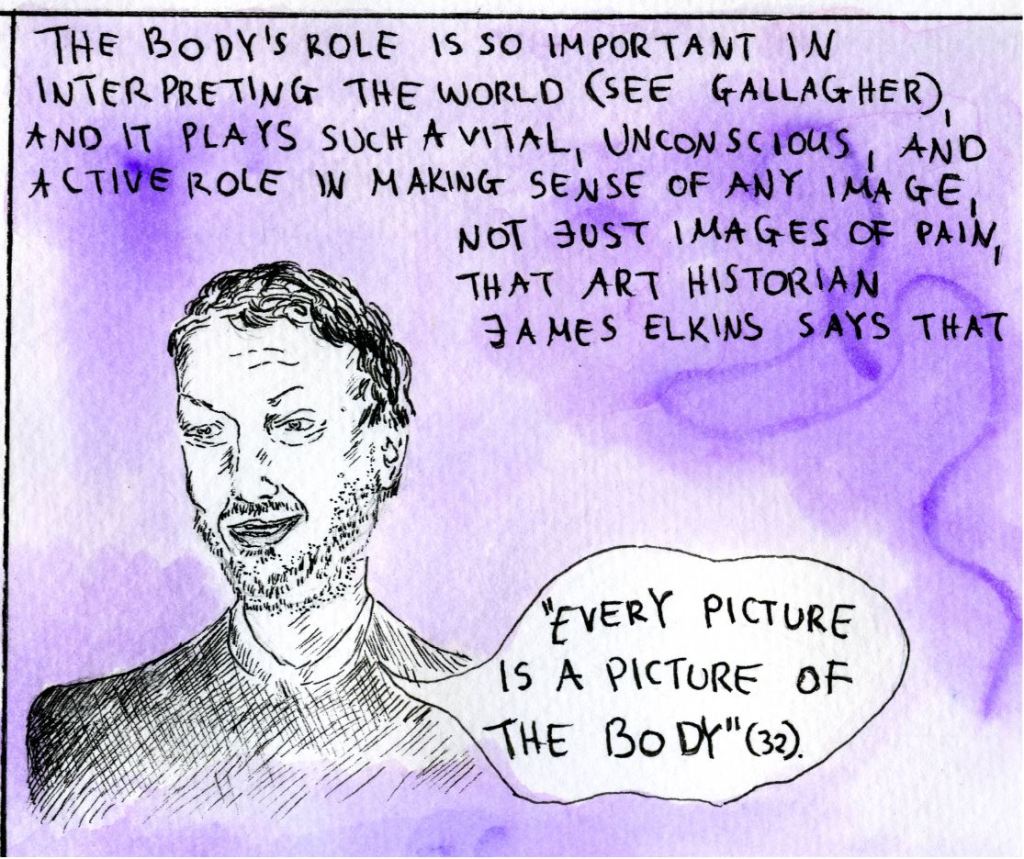
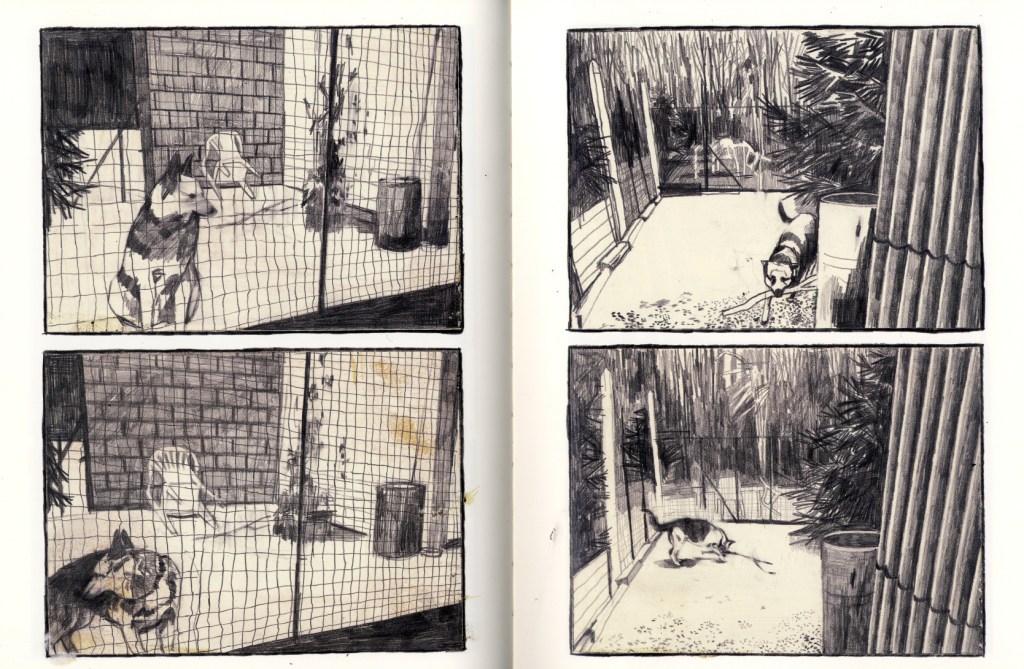
This is an argumentative piece on some of the ways in which our bodies are involved in reading comics. It draws on theories by Laura U Marks, Robert Vischer, and James Elkins. The text and the art together show that there is more to comics than what meets the eye: in fact, we interpret lines, dynamism, direction, texture, movement based on the experiences of our bodies. These ideas are also found in my book, Comics and the Body, which will come out in November 2020 with the Ohio State University Press.
The artist who illustrated it is Boglárka Littner, a really smart young artist who is my mentee at Milestone Institute, Budapest and who is interested in making comics and sculptures.
Here is the abstract of the presentation I am going to give at the Comics and Art and Design conference of the Comics Forum in Leeds, 7-8 November 2019. Cannot wait! This conference is always so inspiring.
The starting point of my investigation is that comics is a drawn medium, and that this fact has intriguing consequences on how comics narratives work, how they are made, and how they are interpreted. Though there is a growing number of studies of drawing coming from comics scholarship (e.g. Gardner, Baetens, Grennan), in my presentation I apply theories of drawing coming from art history to the study of comics. Obviously, there is no direct correspondence, but I believe questions asked by art historians facilitate creative and fruitful rethinkings of the significance of drawing in comics. Focusing on drawing directs attention to comics as a process and not as a product, as well as to the transmissive nature[1] of reading comics and engagement with them.
I will primarily rely on Norman Bryson’s “A
Walk for a Walk’s Sake” (2003) and Karen Kurczynski’s “Drawing is the New
Painting” (2014), and I will provide readings Dominique Goblet’s Pretending is Lying (2007) inspired by
Bryson’s and Kurczynski’s insight. I will examine associations of rawness and
immediacy in Goblet’s comics, and I will contrast these to the drawn
photographs she also includes in her narrative. Techniques of erasure are
present in both Goblet’s “raw” and “photographic” images, while erasure is a
central topic of the graphic memoir itself. I will also argue that Pretending is Lying can be seen as a
work in the state of becoming, one that is understood not simply by our
cognitive capacities, but by the special ways our bodies understand lines.
[1] Jill Bennett
described art as transmissive in Empathic
Vision (2005).


 Eszter Szép