In October 2021 I was invited by Lina Ghaibeh to hold a lecture to graphic design students about drawing and comics. I was and am still honored by this opportunity.


Curious about comics.
Get updates about news and blog posts.
2020 was the most productive year in my life if we look at the number of academic and non-academic publications – I have to add that a number of them were written in 2018. On a personal level, 2020 was difficult because of the isolation of COVID, my own weeks of being ill, and because of the lack of success in finding an academic or cultural job.
was quitting my job in June. I was working at a multinational company in the IT sector, and each and every cell of me felt that I do not belong there.
Without full time employment I could immerse myself in stuff that I would otherwise do after work or not at all. I am most proud of the marketing campaign of the International Comics Festival: this year it was small and it lacked international guests, and in the campaign comics artists and other comics-related people told the audience why they like comics. As comics is still considered a childish and dubious medium in Hungary, I consider this a campaign for social change.
was that each and every one of my job and scholarship applications was rejected. I was applying for jobs in Hungary and abroad, and it seems that I am too inernational for Hungarian people and too Hungarian for international people; too academic for non-academic people and academic in the wrong way for academic people. I have had some terrible weeks of despair, sleeping issues, and a general sense of “I have no place in this world, I am not young any more, what the shall I do now?” In general, I am looking for ways to work and cooperate and innovate, but this many rejections can really kill one from the inside. And the worst thing is when they tell you that you are an enthusiastic person, you can take everything. This is simply not true.

To motivate myself to keep on doing stuff, reading stuff, and talking about stuff, I started a Patreon page (here is a link). I do not have many backers, but I love each of them. The monthly projects I undertake have possibly saved my life. I need to feel that I can continue my research and scientific communication even without institutional background. (I am reclaiming ‘scientific communication’ from the hard sciences.)
is that my book has been published! It is basically 1/3 my dissertation and 2/3 not my dissertation, and I still cannot believe it that a top American publisher published it. I hope that people will find ideas in it that they can use, that inspires them, and I also hope that it will not be the last book I have written. More about my book here. And this is the publisher’s site.
Another unbelievable event is that I was invited to talk about my book and my other projects in Frederick Louis Aldama’s videocast. I love this series, Frederick has made interviews with many inspiring comics scholars – I have learned a lot watching the episodes. You can watch the episode with me here.

we started with my friend, István Mráz. We have been talking about it for quite some time, and finally we made it happen. In the first series our topic was the hero in comics. We had two guests, Anita Moskát, the coolest Hungarian fantasy writer, and Kata Gyuris, the coolest expert on African literature I know. The podcast is now in its second season! Youtube. Spotify.
starting my own Youtube channel. Here it is. It is in English, and I will use it to discuss comics and literature.
As you know I am involved with comics life in Hungary. I feel that there is a change happening and there is a general interest in comics. I have been interviewed 7 times (out of these twice on TV, and once in a Facebook Live, and I also talked about Stan Lee in “Lapozz a 99-re” podast), though not about my work but about the history of comics in Hungary, in the US, and the comics world in Hungary. I have no idea how many people watch cultural programmes on state TV channels in the Hungarian media environment, am really happy that offline and online cultural magazines have opened up towards comics.
I start with the academic ones:

I believe that my analysis of Miriam Katin’s graphic memoirs, published in Documenting Trauma (Palgrave Macmillan, 2020) is one of the best chapters I have ever written. This is greatly due to the questions the editors (Candida Rifkind and Dominic Davies) asked me or ideas they suggested elaborating or restructuring. Katin’s work is also part of my book: whereas there I study the embodied nature of its art and of my reading process, here I look at the representations of the maternal body and of the mother tongue.

I was invited to write about Hungarian comics in Comics of the New Europe (Leuven UP, 2020), a collection focusing on Eastern European comics after 1989. This is such an understudied topic! Thanks to the editors, Martha Kuhlman and José Alaniz. My chapter briefly summarizes the history of Hungarian comics and then provides close readings of strips by Gergely Oravecz and Dániel Csordás. Google Books.
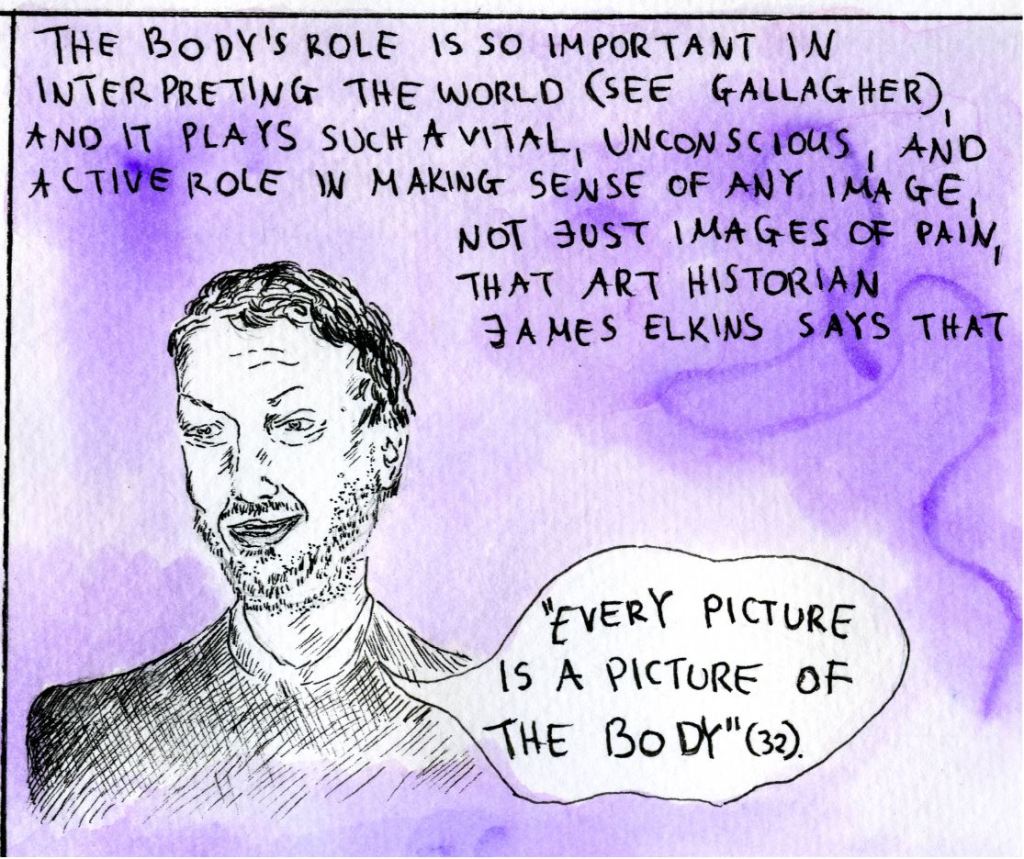
I work as a mentor to gifted teenagers at Milestone Institute, and with my mentee, Boglárka Littner, we made a comic. As the title, Lines and Bodies, suggests, this is an argumentative comic related to my research. I learned a lot while discussing with Bogi what these sometimes abstract ideas mean, while figuring out how I could simplify them, and while brainstorming how we could turn this train of thought into a comic. Boglárka is a sensitive and smart artist, I love her illustrations. You can read the comic online: Link.
I wrote one review for TCJ (The Comics Journal) on Swimming in Darkness (Link), two more are coming up in the first quarter of 2021.
At the end of the year an unexpected opportunity found me: I started writing weekly reviews and articles in the magazine 168 óra. Though this work does not allow me to make a living, it allows me to think and write about comics, novels, films, animation, and HBO/Netflix series. Here are the articles I have written. (They are in Hungarian.) My favorite article is about Brian Cox and David Ince’s book and podcast, The Infinite Monkey Cage.
 Eszter Szép