One of the greatest honors of my life has been to keynote at the joint conference of IGNCC and IBDS (International Graphic Novels and Comics Conference, International Bande Dessinée Society).
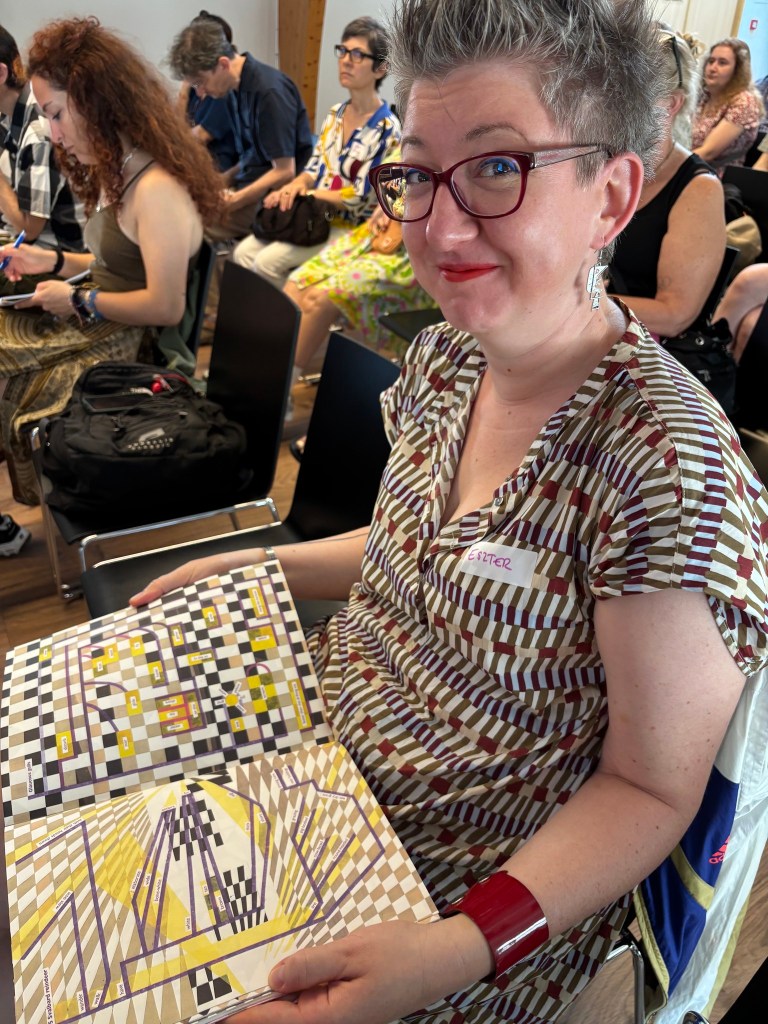
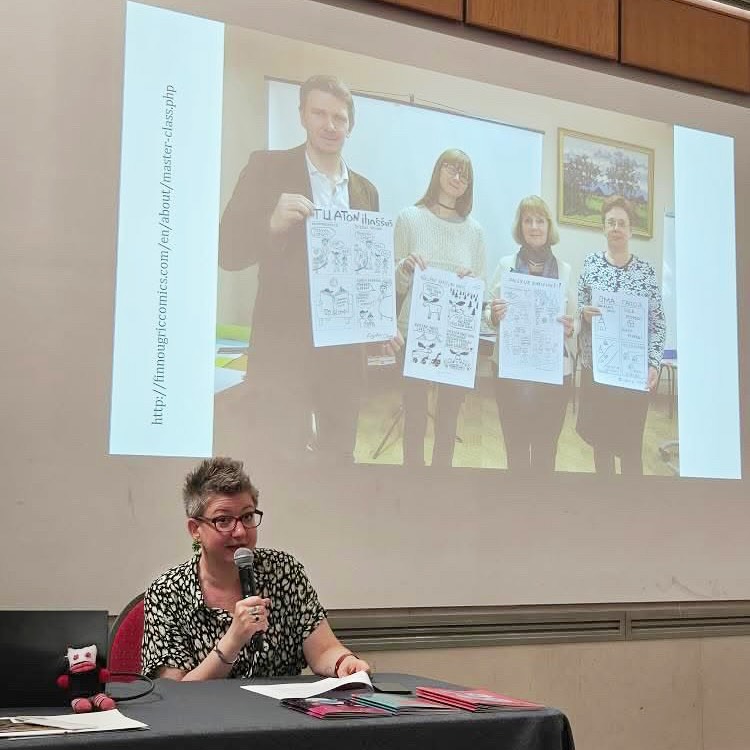
The in-person week of the conference took place between Mon 30 June – Fri 4 July 2025 in Brussels, Belgium, and I spoke on the last day. One of the best personal experience has been to reconnect with my comics mentors and friends! I missed this. I also made new friends. I was super nervous and this community is just so supportive, friendly, and welcoming.
I’m so grateful.
I dedicated my talk to fellow freelance academics and Eastern European academics and those who write 10000000000 letters of recommendations, involve us in projects, are simply there to chat. I know that the whole academic world is in a precarious situation, of course.

Here’s the intro to my talk, titled  Comics as Encounter and Research:
The question that I keep on returning to recently is where is the place of comics in the world? With the words of Donna Haraway, “if we could only have one word for these SF times, surely it must be the Capitalocene” (Staying with the trouble, p 47). Where is the place of comics and comics studies in global neoliberal capitalism – and in illiberal democracies?
I suppose many valid answers can be given to this question —depending on which aspects of the Capitalocene we focus on and how we approach comics. In my approach, comics are invitations to experience and perform mediated and embodied interactions, comics are dialogues between embodied makers and embodied readers relying on strategies of representation and interpretation in words, in images, in time, in space, and in materiality. From this vantage point, the loss of connection between people and communities, extreme polarization along political lines, the inability to listen, the prevalence of loneliness, the overuse of disembodied virtual apps, seem especially urgent.

The potential of comics to create communities, to re-emphasize the local, to establish material connections will be the topic of this talk, and I invite you to think through these questions with the help of four comics and zines from the non-Anglo-American tradition, some of which encourage us the extend our definitions of what comics are and what they can do. I also would like to think about the idea of comics as research.
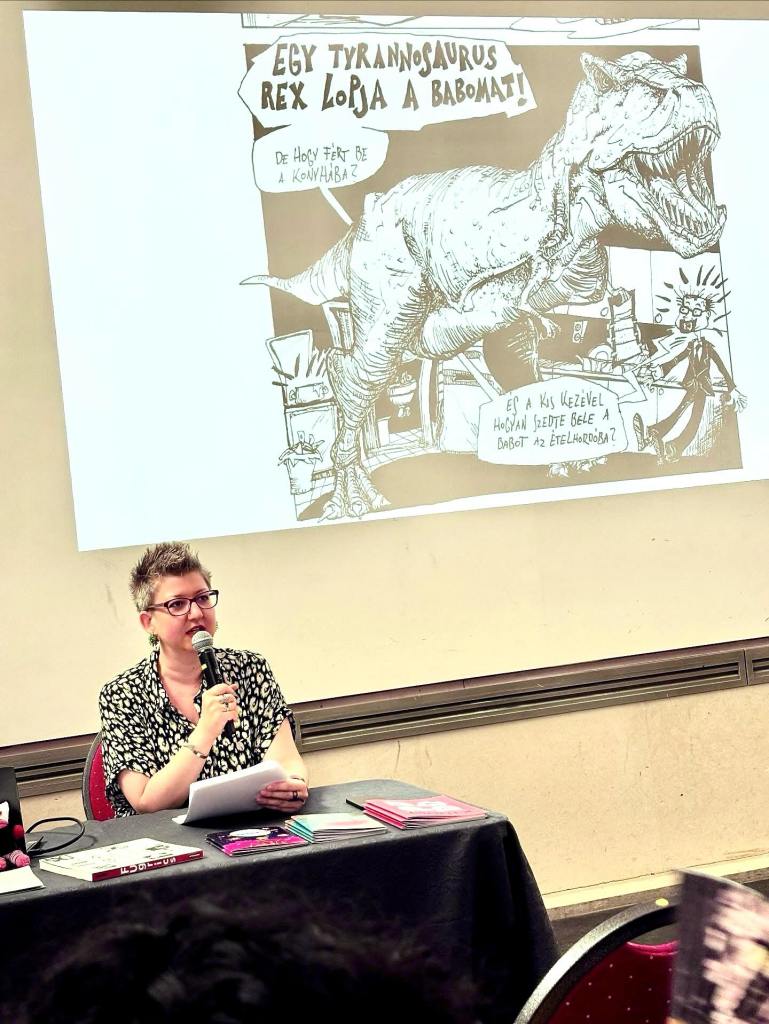
At the end people could come and have a look at the comics and zines I was talking about, namely the Finno-ugric comics project, the @groundtableee project, the @random_factor_comics zine (Complex) and my students’ comics. Pictured here is “Chili” by Hungarian comic artist István Lakatos, a comic on the contradicting expectations cartoonists have to navigate — the audience found it hilarious.
Abstract
I am often asked to define comics in various non-academic contexts and I have become a pro in defining and defending comics with the help of formal and historical considerations. However, the conversation is rarely long enough for me to expand on a question that really interests me: how does our perception of what comics is and what it can do change if we think of it as encounter? What new questions can we ask if we consider comics as possibilities for actors to meet? In this talk, I apply this model for comics as encounter on research comics. Comics is increasingly used not only to present research but also to be the very medium of research. My case studies are two projects of comics as research and as encounter, namely the anthropological zines of the Groundtable collective (Germany-Thailand-Hong Kong-Australia) about cooking habits and Sanna Hukkanen and Anna Voronkova’s anthropological research as comics in FUgrics: Comics from the Finno-Ugric World (2020).
 Eszter Szép