One of the greatest honors of my life has been to keynote at the joint conference of IGNCC and IBDS (International Graphic Novels and Comics Conference, International Bande Dessinée Society).
Curious about comics.
Get updates about news and blog posts.

This past year I’ve been part of the History in Comics research project, initiated by Eli Woock at Palacky University, Olomouc, Czech Republic. We have had meetings, presentations, and discussion every second month, and we have had a great time. This research group meant that I could get connected to other comics scholars and I could think about questions that are not part of my usual what the fuck is going on in Hungary? routine. I have learnt a lot from the project participants, who are:
(more…)This is the abstract of the paper that I will present next week in Dún Laughaire at the International Graphic Novels and Comics Conference. The theme of the conference is “Comics and Conscience: Ethics, Morality, and Great Responsibility”
Before the actual video, I also would like to share sketchnotes made by fantastic artist-researchers during the talk – thank you Muna, John, and Paul!
This sketchnote is by Dr Muna Al-Jawad, aka The Old Person Whisperer, who was the official sketchnoter of our panel:
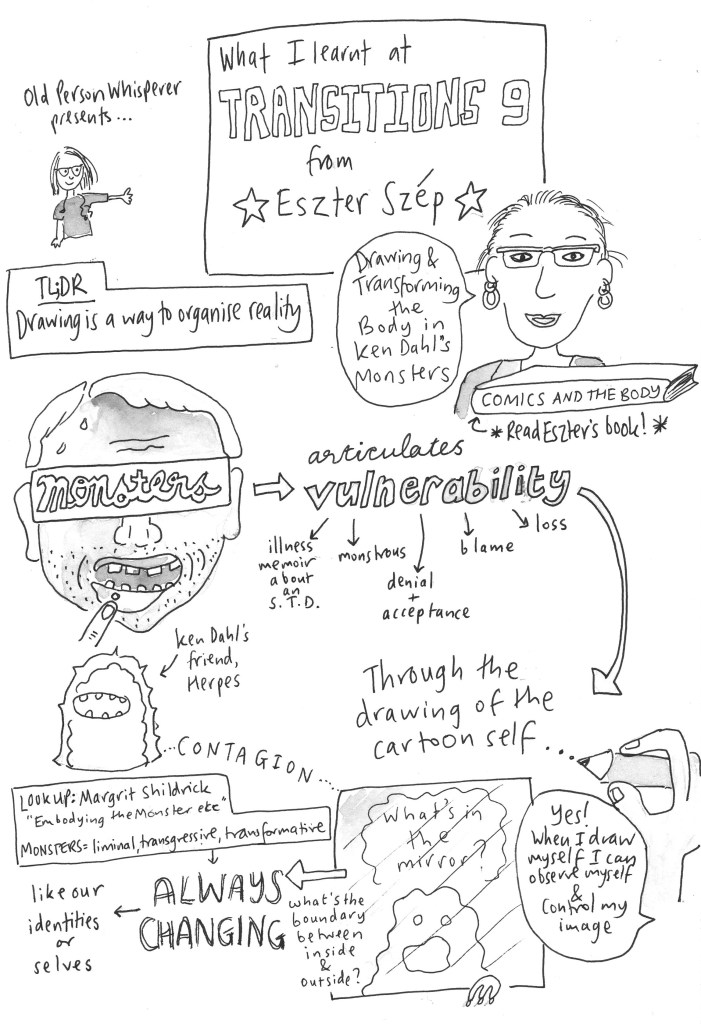
Dr John Miers also made sketchnotes:

And Dr Paul Fisher Davies mentions this talk in his sketchnote on our panel:

And now the video:
PS: This talk is based on Chapter 2 of my book, Comics and the Body: Drawing, Reading, and Vulnerability.
This is my abstract for Transitions 9: New Directions in Comics Studies 2021 (Transitions was canceled in 2020 but will take place online this year – 2021. There will be live sketchnoting during the panels! I’ll speak on 8 April about a chapter of my book that I’ve not talked about at any conferences before. – Check out the full program here.)
Ken Dahl, in his graphic narrative on living with the sexually transmitted disease of herpes, represents his avatar and personifies the illness of the avatar with cunning visual inventiveness. Dahl’s dynamic visualizations freely transform the bodies of the characters, which, I argue, emphasize drawing as a performance and as a way to think about the many controversial topics of this comic (eg. relationships, responsibility, sex, guilt, prejudice). Bodies are constantly created and recreated in acts of drawing, which offer creative ways for Dahl (pen name for Gabby Schulz) not only to find visual expressions of complex feelings and experiences regarding illness but also to testify to the endlessness of pictorial embodiment (El Refaie) itself.
The metamorphoses keep the avatar in what Margrit Shildrick called the “condition of constant becoming” (1): in a particularly vulnerable state where the repeated acts of transforming the avatar’s body are used to ask visual questions about the body. Shildrick does not talk about comics, her book, Embodying the Monster: Encounters with the Vulnerable Self, studies monstrosity and vulnerability in various cultural products: my paper applies Shildrick’s questions to Dahl’s take on normative and the monstrous bodies. I show with examples and by close reading that the morphing of the avatar’s body is expressive of vulnerability on two levels: on the level of the narrative where the illness is transforming the body, and on the level of representation, where it is the lines that govern the transformations of the body.
Content warning: Dahl uses a cartoony style to show a sexually transmitted disease, but occasionally he switches to a very realistic, photoreferential way of drawing, which can be disturbing. Actually these changes are extremely interesting.
Some personal notes:
– this conference presentation is based on chapter 2 of my book, Comics and the Body, which has, I am so happy to say, entered production phase!
– I cannot wait to meet the fantastic members of the comics community in the UK and to talk to keynote speaker Nick Sousanis again! I am 100% sure this will be a most inspiring conference!

I am looking forward to the 2021 conference of the Comics Studies Society. The topic this year is Re/Building Community. Here is my abstract.
The Wall: Growing Up Behind the Iron Curtain is Petr Sís’s multiple award-winning graphic memoir about his childhood in what is now the Czech Republic and what used to be Czechoslovakia. In my presentation I argue that contrasting public space – a space of politics, social pressure, and danger – and private space – hidden and small places of creative self-expression – is a central topic of the memoir. Sís’s narrative successfully mobilizes page design, that is, the distribution of drawn elements in space, in order to illustrate and demonstrate the spatial tensions of life under Communism. I will study the visual metaphors that playfully represent the persistent revolt of a community.
I show that the narrative can be interpreted as a creative protest against intellectual, political, and physical walls and borders: on each page, Sís reinterprets the revolt against the wall as a symbol and as a physical presence. In The Wall, the creative individual cannot be limited by walls imposed upon it and the walls isolating the individual from the community. Art is shown as self-expression and as a link between people, but also as a dangerous activity threatening the artists themselves in a system of surveillance. Art – be it drawing on a canvas or on a wall or playing in a band – is shown in the pictures as indispensable to bringing the wall down. At the same time, the textual layer drags these almost idealistic scenarios down to earth by providing details about the political and cultural contexts of Communism.

Lynda Takes the Line for A Walk: Attitudes and Philosophies of Drawing in Lynda Barry’s Comics
Transitions 8, 10 November, Birkbeck, University of London (detailed program)
Lynda Barry’s What It Is (2008), Picture This (2009), and Syllabus (2014) are not simply educational or self-help books on making comics, they reveal Barry’s theory about drawing and about creation. In my presentation I examine what Barry’s explanatory texts, creative exercises, and autobiographical comics inserts reveal about her philosophy of drawing.
In her exercises designed for either students or readers to engage in making drawings, Barry emphasizes the importance of bodily engagement in thinking and in creation. This idea appears in comics scholarship as well, but, unlike scholars, Barry thinks of the line as a trace of one’s personality. This way Barry engages in an ongoing discourse on the authenticity/conventional nature of the line in comics. Authenticity in non-fiction storytelling has become possibly the most overinvestigated term in the study of comics autobiography and journalism, but the relationship between the line and the drawer and the line and the story has not been studied that much.
While approaching Barry’s work, I reach back to theories of drawing by Jan Baetens, Hillary Chute, Jared Gardner, Simon Grennan, Philippe Marion, Nick Sousanis, and parallel theories in contemporary approaches to drawing in contemporary art, namely by Karen Kurczynski, Elizabeth A. Pegram, Katherine Stout. Philip Rawson’s Drawing and Laura U. Marks’ recent article “I Feel Like an Abstract Line” have shaped my understanding of the line and provide the starting point of my analysis of Barry’s work.s
As the title of the presentation hints, I believe Barry’s idea of drawing a line is closely related to that of Paul Klee. I will show that, similarly to Klee, Barry considers the line as a partner of the drawer. I also offer close readings of some of the drawing exercises Barry designed for her students and for the reader, and these pages will serve as prompts to illustrate the already mentioned theories on the nature of the drawn line.

Here is the abstract of the paper I’m going to present at the Ninth International Graphic Novel and Comics Conference, Retro! Time, Memory, Nostalgia, @Bournemouth University, UK, 27-29 June 2018
“Postmortemistical” Look: The Memory of Things and the Traces of Personhood in Roz Chast and Ben Katchor
The paper investigates the ways personal relationships and memories are organized around objects and things, and how these are rearranged once the object/thing is no longer possessed by a person (due to death in Chast’s memoir, and due to abandonment in Katchor’s strips). Objects are represented in both examined comics, that is, in Roz Chast’s memoir about her last years with her parents and their deaths, Can’t We Talk About Something More Pleasant? (Bloomsbury, 2014) and Ben Katchor’s collection of strips, Julius Knipl Real Estate Photographer: Stories (Little, Brown and Company 1996), as sites of a conflict between personal memory and an apersonal and atemporal existence.
In the paper I argue that in both Chast’s and Katchor’s comics, things and objects (cf. thing theory) exist in a limbo, and are used to investigate personality and personhood in scenarios of absence. Can’t We Talk About Something More Pleasant? introduces the idea that objects, such as hairbrushes, bankbooks, photographs, and forgotten everyday objects play important and multiple roles in facing the frailty of memory, dementia and death. Things, for example old color pencils found in a drawer, represent both the past and the present, they simultaneously stand for deep personal connections and fond, and are accumulated junk the existence of which indicates future problems (can it be touched? can it be thrown away?). Likewise, Ben Katchor’s Julius Knipl Real Estate Photographer asks questions about the meaning of objects/things left behind: they exist simultaneously in a vacuum of interpretation and in the actuality of physical space. The things and objects are left behind, forgotten, stored, reserved, measured, bulked and sold, but most importantly, they are looked at and represented. The paper investigates the “postmortemistical” look (Chast) that frames these objects for the reader of the comics.
The paper utilizes questions raised by thing theory (Bill Brown and Jane Bennett), and it also builds on the materiality of living and the idea that even everyday and banal places preserve memory (reflecting on Pierre Nora’s concept). As far as methodology is concerned, I use close reading and compare recurring tropes.

Documenting Trauma: Comics and the Politics of Memory
A Symposium hosted by the TORCH Network
University of Oxford, 22.06.2017
Joe Sacco’s reportage has often been studied in ethical frameworks, as his comics have shed light on both the background of journalistic work and on the creation of narratives in the comics form. Sacco’s comics contribute to human rights discourse and the narratives have played important parts in revealing the complexities of armed conflicts for a Western public.
In my paper I read Sacco’s comics on the Bosnian War and study the connection between style and ethical engagement in the narratives. I explore the capability of drawing style to express engagement and compassion with the pain and vulnerability of the Other, and argue that Sacco has a compulsive relationship to drawing, which supersedes his often mentioned meticulous attention to detail. I show that the role of crosshatched backgrounds in Safe Area Goražde (2000) and The Fixer: A Story from Sarajevo (2003) create a different temporality for both the artist and the reader, the temporality of dwelling (Diprose). I show that the heavily crosshatched haptic surfaces foreground the labour of the artist, and represent his embodied presence in the work. The haptic surfaces are just as important in panel compositions as the figures giving testimony, and are expressive of an intensive, laborious and time consuming engagement with both the materials used for drawing and, more importantly, with the traumatized person who is being drawn. In the close readings of certain panels and page structures I also rely on Norman Bryson’s theory of the logic of the gaze, as well as on Laura U. Marks’ now classic investigation of haptic visuality, and ultimately show that style, and not only the choice of topic or the nature of narratives, can be representative of ethical issues.
Literature
Bryson, Norman. Vision and Painting: The Logic of The Gaze. Macmillan, 1983.
Diprose, Rosalyn. “Corporeal Interdependence. From Vulnerability to Dwelling in Ethical Community.” SubStance, vol. 42, no. 3, 2013, pp. 185-204.
Marks, Laura U. The Skin of the Film: Intercultural Cinema, Embodiment, and the Senses. Duke University Press, 2000.
I’ll be talking at a panel at the 7th International Comics and Medicine Conference in Dundee in a couple of days (link). The topic of this year’s conf is “Stages and Pages”, and here is my abstract:
Presence and Disappearance – The surface of the page and narrating sexual abuse in the works of Debbie Drechsler and Katie Green
The paper focuses on autobiographically motivated graphic narratives, namely Debbie Drechsler’s Daddy’s Girl (1996) and Summer of Love (2002) and Katie Green’s Lighter than My Shadow (2013), and examines representations of the violated female body in relation to the surface of the page. Both authors use the expressive power of background, and build on the emotional potential of patterns against which the body is performed. Furthermore, both Drechsler and Green utilize the notions of presence and absence their visual representations of deeply traumatized heroines.
Drechsler deconstructs the idea of form and background in her tragic and disturbing stories about incest: she often visually disguises her female protagonists by making them blend in with backgrounds. Simultaneously, her work features backgrounds of dark rhythmic patterns, minute strokes, curves as a canvas on which the character’s emotions and moods can be represented. Green uses a system of visual markers of anorexia, anxiety and guilt – such as the gaping mouth or the black cloud of scribble – not only to indicate the emotional state of her protagonist, but on a different level also to structure the pages and the connect layout with content.
In the works of both Drechsler and Green, emotionally motivated visual markers eventually influence the very structures of the narratives, and in Green’s case, the very format of the published work. The very body of this heavy, more than 500-page long book that promises lightness in its title can be interpreted as a metaphor for the body – think, for instance, about its scrapbook-like design and the disintegration of the protagonist’s body
Apart from form and pattern, absence will also be studied: Green’s sequence of black (142-145) and white (384-386, 388) pages will be interpreted as performative gestures and performative spaces where the anorexic body is present by its disappearance.

 Eszter Szép