The new project that I am undertaking with the help of Patreon folks is partly a conference presentation and partly an issue I have wanted to explore for a while now.
I have been interested in how postcolonial theories could be used on postsoviet life and stuff – this is happening in literature and in flim, but comics haven’t been studied in this respect. Or not enough.
2020 was the most productive year in my life if we look at the number of academic and non-academic publications – I have to add that a number of them were written in 2018. On a personal level, 2020 was difficult because of the isolation of COVID, my own weeks of being ill, and because of the lack of success in finding an academic or cultural job.
1) The best decision of the year
was quitting my job in June. I was working at a multinational company in the IT sector, and each and every cell of me felt that I do not belong there.
Without full time employment I could immerse myself in stuff that I would otherwise do after work or not at all. I am most proud of the marketing campaign of the International Comics Festival: this year it was small and it lacked international guests, and in the campaign comics artists and other comics-related people told the audience why they like comics. As comics is still considered a childish and dubious medium in Hungary, I consider this a campaign for social change.
2) The biggest disappointment
was that each and every one of my job and scholarship applications was rejected. I was applying for jobs in Hungary and abroad, and it seems that I am too inernational for Hungarian people and too Hungarian for international people; too academic for non-academic people and academic in the wrong way for academic people. I have had some terrible weeks of despair, sleeping issues, and a general sense of “I have no place in this world, I am not young any more, what the shall I do now?” In general, I am looking for ways to work and cooperate and innovate, but this many rejections can really kill one from the inside. And the worst thing is when they tell you that you are an enthusiastic person, you can take everything. This is simply not true.
To motivate myself to keep on doing stuff, reading stuff, and talking about stuff, I started a Patreon page (here is a link). I do not have many backers, but I love each of them. The monthly projects I undertake have possibly saved my life. I need to feel that I can continue my research and scientific communication even without institutional background. (I am reclaiming ‘scientific communication’ from the hard sciences.)
3) The most amazing and miraculous thing
is that my book has been published! It is basically 1/3 my dissertation and 2/3 not my dissertation, and I still cannot believe it that a top American publisher published it. I hope that people will find ideas in it that they can use, that inspires them, and I also hope that it will not be the last book I have written. More about my book here. And this is the publisher’s site.
Another unbelievable event is that I was invited to talk about my book and my other projects in Frederick Louis Aldama’s videocast. I love this series, Frederick has made interviews with many inspiring comics scholars – I have learned a lot watching the episodes. You can watch the episode with me here.
4) I am really proud of the podcast
we started with my friend, István Mráz. We have been talking about it for quite some time, and finally we made it happen. In the first series our topic was the hero in comics. We had two guests, Anita Moskát, the coolest Hungarian fantasy writer, and Kata Gyuris, the coolest expert on African literature I know. The podcast is now in its second season! Youtube. Spotify.
5) While I was sick with COVID, I was dreaming about
starting my own Youtube channel. Here it is. It is in English, and I will use it to discuss comics and literature.
As you know I am involved with comics life in Hungary. I feel that there is a change happening and there is a general interest in comics. I have been interviewed 7 times (out of these twice on TV, and once in a Facebook Live, and I also talked about Stan Lee in “Lapozz a 99-re” podast), though not about my work but about the history of comics in Hungary, in the US, and the comics world in Hungary. I have no idea how many people watch cultural programmes on state TV channels in the Hungarian media environment, am really happy that offline and online cultural magazines have opened up towards comics.
6) Finally, here is a list of my publications in 2020:
I start with the academic ones:
I believe that my analysis of Miriam Katin’s graphic memoirs, published in Documenting Trauma (Palgrave Macmillan, 2020) is one of the best chapters I have ever written. This is greatly due to the questions the editors (Candida Rifkind and Dominic Davies) asked me or ideas they suggested elaborating or restructuring. Katin’s work is also part of my book: whereas there I study the embodied nature of its art and of my reading process, here I look at the representations of the maternal body and of the mother tongue.
I was invited to write about Hungarian comics in Comics of the New Europe (Leuven UP, 2020), a collection focusing on Eastern European comics after 1989. This is such an understudied topic! Thanks to the editors, Martha Kuhlman and José Alaniz. My chapter briefly summarizes the history of Hungarian comics and then provides close readings of strips by Gergely Oravecz and Dániel Csordás. Google Books.
I work as a mentor to gifted teenagers at Milestone Institute, and with my mentee, Boglárka Littner, we made a comic. As the title, Lines and Bodies, suggests, this is an argumentative comic related to my research. I learned a lot while discussing with Bogi what these sometimes abstract ideas mean, while figuring out how I could simplify them, and while brainstorming how we could turn this train of thought into a comic. Boglárka is a sensitive and smart artist, I love her illustrations. You can read the comic online: Link.
I also published an academic text in Hungarian: it is on children’s comics, and you can find it here.
My non-academic publications
I wrote one review for TCJ (The Comics Journal) on Swimming in Darkness (Link), two more are coming up in the first quarter of 2021.
At the end of the year an unexpected opportunity found me: I started writing weekly reviews and articles in the magazine 168 óra. Though this work does not allow me to make a living, it allows me to think and write about comics, novels, films, animation, and HBO/Netflix series. Here are the articles I have written. (They are in Hungarian.) My favorite article is about Brian Cox and David Ince’s book and podcast, The Infinite Monkey Cage.
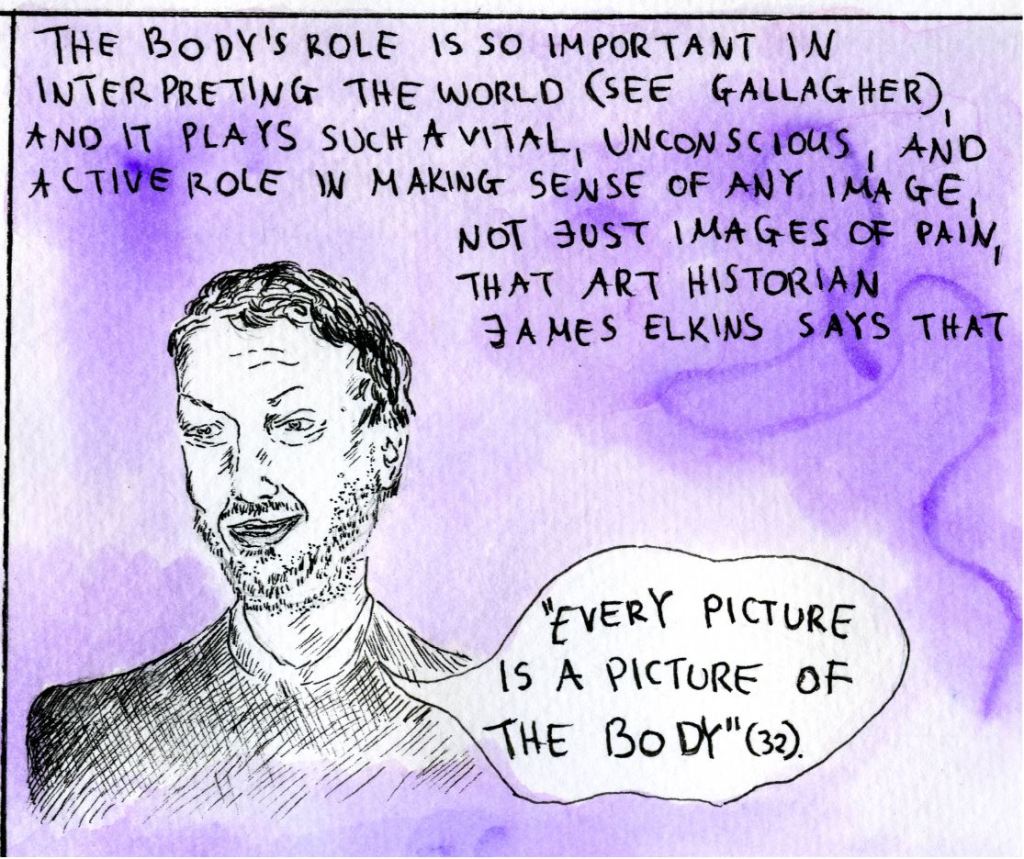
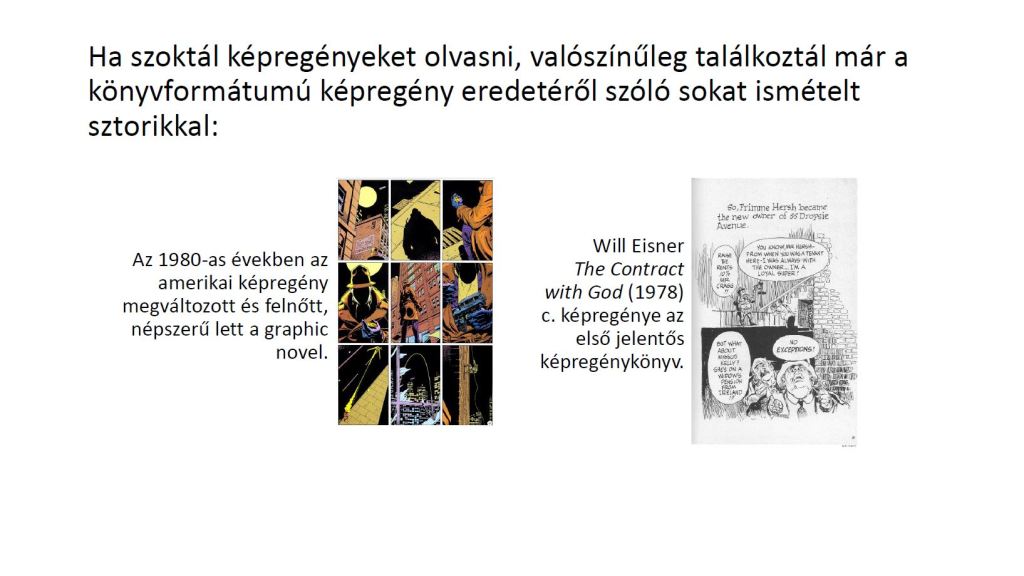
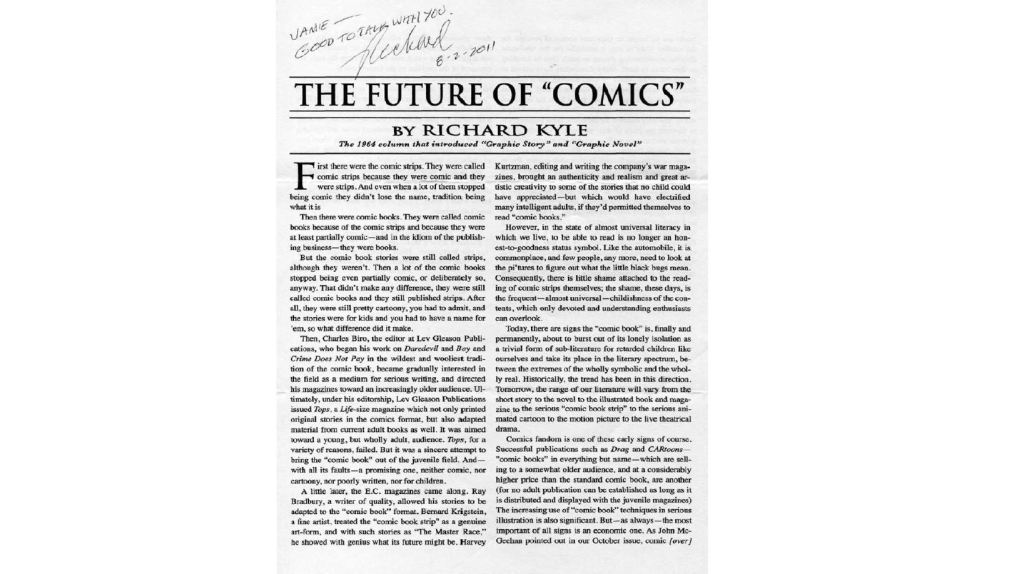
Contrary to the myths inherited from the 80s and later, the graphic novel was not invented or made popular exclusively by Will Eisner or his manager. In my latest Patreon project I dig into the origins of the graphic novel format and I also explore the origins of the term. A teaser of the project is now available for anyone on my website.
The project itself is longer than this teaser and is more argumentative. It is based on Dreaming the Graphic Novel by Paul Williams (Rutgers UP, 2020). I absolutely recommend this book. And my Patreon! Have I mentioned my Patreon in this paragraph yet?
The project on Patreon (ha!) shows that in the 60s and 70s many people had many ideas about how comics should be rethought. Yes, creators, publishers, editors, retailers thought that comics was in need of some change.
I do not dwell on this moral and financial crisis for long in my Patreon project (check!) , instead, I show the diversity of things people were doing and thinking AT THE SAME TIME. This is a dynamic and exciting age: noone knew that the graphic novel will turn out to be successful. They did not know it would be called graphic novel!
Why Patreon? I am experimenting with new formats to keep on doing research, thinking, and discussing ideas. As some of you know, I am outside Academia, which gives me a hard time, but I have watched dozens of Neil Gaiman motivational speeches and I am actively looking for alternative ways to share what I know and to learn from you all.
Distinguished guests, behold the project teaser:
The argumentation and further details of how people were experimenting with long format comics is available on Patreon, where my previous project is also available: You can also listen to an audio/podcast/thing on Ursula K. Le Guin’s Earthsea cycle. Here is the link: patreon.com/eszterszep
Ellentétben a 80-as években (és utána) népszerűvé vált mítoszokkal, a graphic novelt nem Will Eisner vagy a managere találta ki vagy kezdte el népszerűsíteni. A graphic novel szót 1964-ben alkotta meg egy egészen konkrét ember egy egészen konkrét szándékkal – és a hetvenes évek folyamán igen sokan használták.
Legutóbbi Patreon projectemben annak jártam utána, honnan származik a graphic novel formátum és maga a szó. A hatvanas évek végén és a hetvenes években az USÁ-ban nagyon sokan sokfélét gondoltak arról, hogyan kéne újragondolni a képregényt. Bizony, igen sok alkotó, kiadó, szerkesztő, terjesztő úgy gondolta, hogy ráfér a kifejezési formára az újragondolás.
A projectemben ezzel az anyagi és morális válsággal is foglalkozom kicsit, de leginkább azt mutatom be, hogy mennyire sokféle ellentmondó dolgot gondoltak és csináltak a képregényesek EGYSZERRE. Egy dinamikus, izgi, változó korszak ez: senki sem tudta, hogy a képregénykönyv sikeres lesz, és azt sem, hogy a neve végül az lesz, hogy graphic novel.
Fogadjátok szeretettel ezt a rövide beharangozót, a teljes gondolatmenet (ami a Patreonon olvasható) ennél nyilván részletesebb.
Miért Patreon? Ezzel a formával kísérletezem, hogy a kutatást, a gondolkodást, és a beszélgetést egyetemi lehetőségek híján folytatni tudjam. Nagyon hálás vagyok a támgatóknak morális, anyagi és gyakorlati síkon is: ez az anyag például az egyik támogató kérdése folyamán lett kb 15%-kal hosszabb, mint eredetileg terveztem.
Itt találjátok a részletes gondolatmenetet a korábbi, Ursula K. Le Guinről szóló projecttel együtt: patreon.com/eszterszep
I am happy to share with you my first finished Patreon project.
Patreon projects help me keep on academic work in the circumstances I do not want to waste time on describing now, I have done so here, in the general introduction of my Patreon endeavor. Patreon projects are academic investigations that create a bridge between what I do in English and what I do in Hungarian, and I am really grateful for the patrons for allowing me to carry on thinking.
MY FIRST FINISHED PATREON PROJECT has two parts: a) an essay on Ursula K. Le Guin’s Earthsea cycle in Hungarian and b) an audio / podcast on the same topic in English.
Ursula K. Le Guin is acknowledged as one of the writers who undermined inherited fantasy tropes, wrote different quests and different conflicts, did not use characters who were evil just because they loved being evil, and, importantly, created tons of interesting female characters and made the gender of the characters a decisive factor. There is a sense of deep wisdom in all of her works.
I show that we can understand the Earthsea cycle in a new way if we see that vulnerability is gradually becoming a central topic of the six books of the cycle. I talk about the ethics of vulnerability (which is a key idea in my upcoming book, Comics and the Body), and then I show how this works in the second book of the cycle, The Tombs of Atuan. I tried to give many examples and no spoilers. I think it is understandable even if you haven’t read the book yet. I hope so!













 Eszter Szép