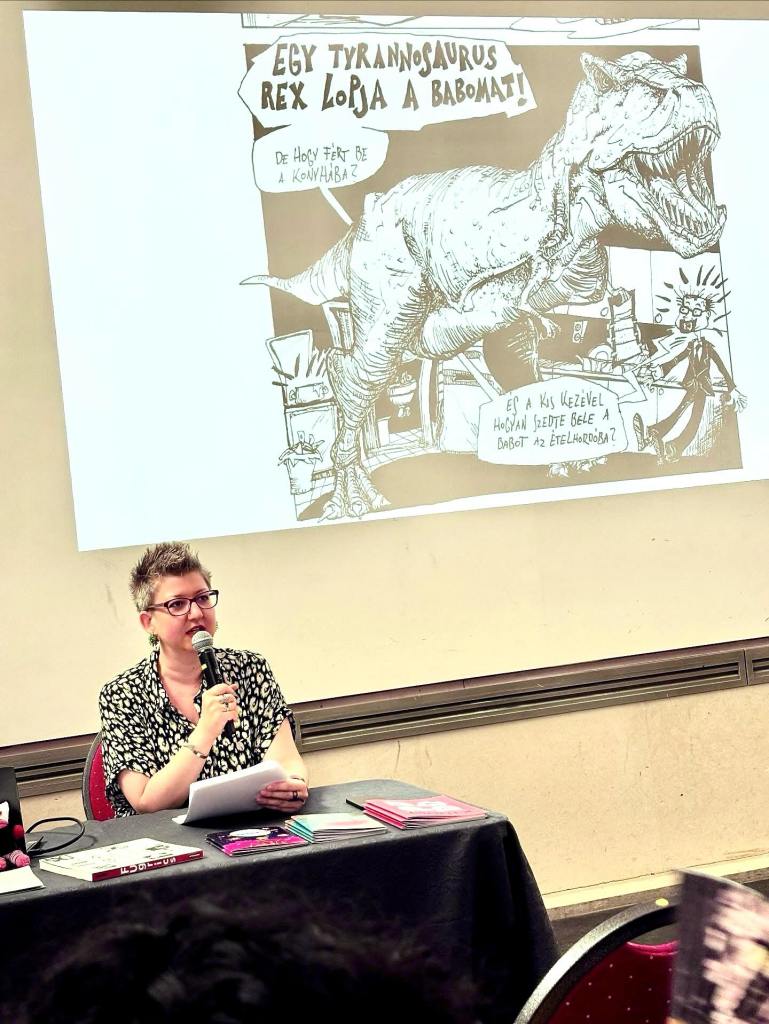
One of the greatest honors of my life has been to keynote at the joint conference of IGNCC and IBDS (International Graphic Novels and Comics Conference, International Bande Dessinée Society).
Curious about comics.
Get updates about news and blog posts.

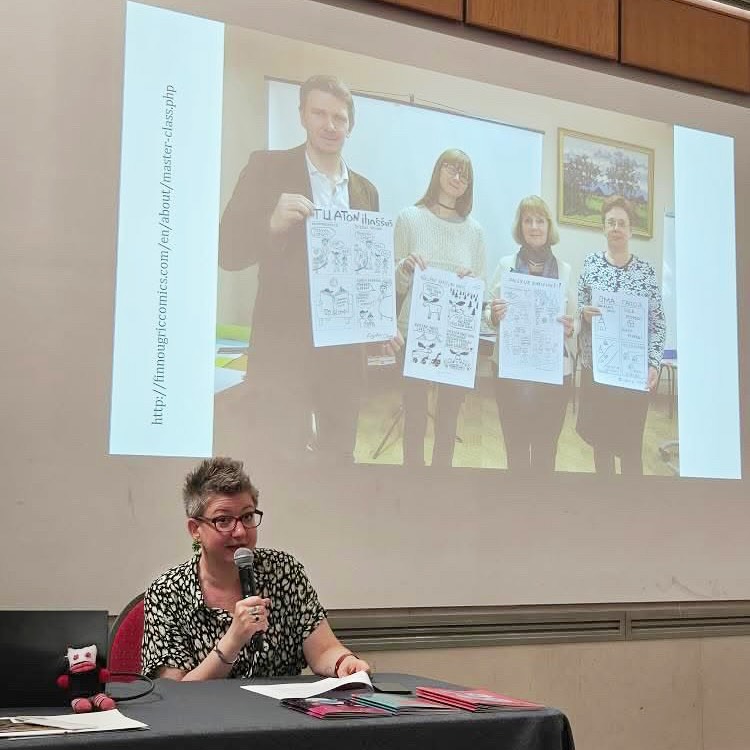
This past year I’ve been part of the History in Comics research project, initiated by Eli Woock at Palacky University, Olomouc, Czech Republic. We have had meetings, presentations, and discussion every second month, and we have had a great time. This research group meant that I could get connected to other comics scholars and I could think about questions that are not part of my usual what the fuck is going on in Hungary? routine. I have learnt a lot from the project participants, who are:
(more…)This is the abstract of the paper that I will present next week in Dún Laughaire at the International Graphic Novels and Comics Conference. The theme of the conference is “Comics and Conscience: Ethics, Morality, and Great Responsibility”

Marie Duval was drwaing to the British humorous-satyrical weekly Judy from 1869, and she started drawing the adventures of the first comics superstar, Ally Sloper. After her death, there were conscious attempts to misattribute her work and to erase her from the history of cartooning and visual journalism.
My project is based on the fantastic book Marie Duval: Maverick Victorian Cartoonist by Simon Grennan, Roger Sabin, and Julian Waite (2020). In the four parts of the project, I explore some of my favourite topics in the book: #1 Duval’s career, #2 women and work in Victorian Britain, #3 the influence of theatre on Duval’s cartooning, and #4 the politics of her drawing style and why it was considered vulgar. Link.
(more…)The day has come when I can proudly share with you that my book has been released! I really enjoyed writing it and discussing my ideas at conferences. I just love this topic. I am really happy now!
I am so grateful for the support of my husband and friends and for EAAS for their postgrad research grant to the Billy Ireland Cartoon Library. Without them and it I really could not have written this book.
In this book I examine the role of the body in drawing and reading comics within a single framework. In each chapter I approach a different aspect of embodied interaction with comics (drawing lines; drawing bodies; drawing style; reading bodies and abstract lines; interacting with a book object). This is an interdisciplinary book that is equally inspired by art practice, feminist ethics, and materiality studies.
If you are interested, I’d like to recommend two videos for further info: In this video I discuss my research with Frederick Louis Aldama.
And I made this short video to introduce the basic ideas of my book:
Amazing cover art by Amanda Weiss.
I am honored to be part of Frederick Luis Aldama aka Professor LatinX’s videocast series: Frederick invites comics scholars to talk about how they got interested in reading and researching comics, what they do, what are the most important questions that drive them.
In the video, I start with how I arrived at comics scholarship: at the end of my MA I was given the best advice ever, namely, that I should not start a PhD unless I am absolutely dedicated to my topic and to this path. So for a couple of years I did other things, I travelled, I worked as a teacher – and I found comics. (My MA was about John Keats, the Romantic poet and John Locke’s philosophy of language.) I also talk about the most important aspects of my book as well as some recent publications and briefly about Hungarian comics.
I recommend listening to other episodes of the series. I have learned a lot from them, and I think it is fascinating to learn about how many different aspects of comics people are researching. This videocast is also very personal, and it is nice to get to know scholars a bit.
My video was released some months ago but I forgot to write about it here.
I am happy to share with you my first finished Patreon project.
Patreon projects help me keep on academic work in the circumstances I do not want to waste time on describing now, I have done so here, in the general introduction of my Patreon endeavor. Patreon projects are academic investigations that create a bridge between what I do in English and what I do in Hungarian, and I am really grateful for the patrons for allowing me to carry on thinking.
MY FIRST FINISHED PATREON PROJECT has two parts: a) an essay on Ursula K. Le Guin’s Earthsea cycle in Hungarian and b) an audio / podcast on the same topic in English.
Ursula K. Le Guin is acknowledged as one of the writers who undermined inherited fantasy tropes, wrote different quests and different conflicts, did not use characters who were evil just because they loved being evil, and, importantly, created tons of interesting female characters and made the gender of the characters a decisive factor. There is a sense of deep wisdom in all of her works.
I show that we can understand the Earthsea cycle in a new way if we see that vulnerability is gradually becoming a central topic of the six books of the cycle. I talk about the ethics of vulnerability (which is a key idea in my upcoming book, Comics and the Body), and then I show how this works in the second book of the cycle, The Tombs of Atuan. I tried to give many examples and no spoilers. I think it is understandable even if you haven’t read the book yet. I hope so!
These past months have been very difficult because it seems that being from Eastern Europe and being primarily a comics scholar (though I have also taught literature) make it impossible to get a job in academia either here in Hungary or in the EU / UK. This has negatively influenced all my other projects, such as our podcast, the various guest posts I write to blogs, the academic articles I should be writing (because I simply do not accept that I should quit) and I became more and more gloomy. I do not want to bore you with this, I am sure you have also had some negative spirals in your life. What usually helps in my case is watching Neil Gaiman interviews and feed on his creative positive energy.
I have also decided to share my work (and also my difficulties) more openly because I love working on/with comics and recently I have felt so dark and alone.
Here is a chain of tweets that explains my motives. You can find my page on patreon.com/eszterszep. I have spent some time in making the tiers personal, have a visit if you have the time.

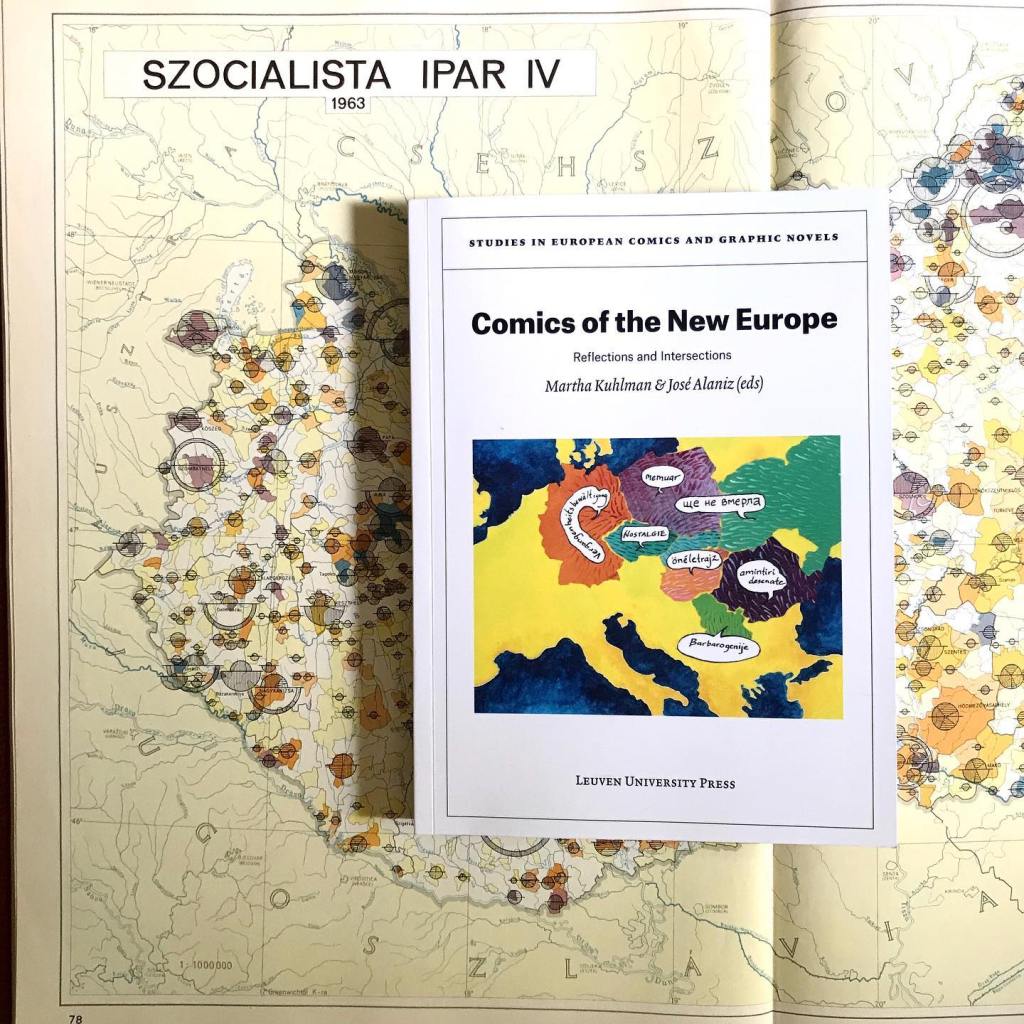
Editors Martha Kuhlman and José Alaniz have found, explored, brought to us a topic that is hardly ever discussed: the comics of Eastern Europe. I am so happy that they thought about Hungary, too, and I could contribute with a chapter on a brief history of Hungarian comics and on contemporary autobiographical comics in Hungary. Thank you, Martha and José, for this collection.
Often, when the phrase “European comics” is uttered, what people mean is French or Belgian comics. However, the countries of Eastern Europe have their own diverse comics traditions. Why are they diverse and what are they like? At the end of the 19th century, magazine culture was hot and trendy in Europe, and the countries of the Austro-Hungarian Empire were no exceptions. Nationalism at the rise, these countries had worked hard to have press in their native languages and not in German. These papers started publishing political satirical cartoons — just like Punch in Britain. In Hungary, these papers often borrowed German and Austrian cartoons and jokes. So the national press, at least in Hungary, was part of a broader European press culture and development of visual culture. We even ripped off the Yellow kid!
However, before WW2 in Hungary Jewish-owned businesses were banned, and this affected many magazines and periodicals. After WW2, under the Soviet invasion, comics were banned as they were considered to have bad imperialistic American ideological influence.
After a while, especially after the 1956 unsuccessful revolution against Soviet rule, some entertainment was offered to the people as diversion, and a few pages of comics were also published in some magazines of entertainment. These comics were adaptations of literary works, and were hugely popular.
In Hungary, comics from the 1950s onward developed completely without American influence (some left-wing French stuff was translated later, though), and the ideological decision to exclude imperial influence had very material and aesthetic consequences: these comics look very different.
During Soviet rule, each country in Eastern Europe had their own comics traditions, and after 1989 they each developed different discourses in the medium of comics. I am so happy that I could contribute with a chapter on contemporary Hungarian comics. Interestingly, we do not really have works that would study our past in a reflective or personal way (yet). I have seen in Comics of the New Europe that some countries have very serious and interesting working through going on in comics. I cannot wait to find out more about the collection, the Introduction, which I have had time to read so far, is really interesting.
More on the book on the homepage of Leuven University Press.


University of Nebraska Press has launched its comics studies series with a long-needed focus: “By looking at understudied and overlooked texts, artists, and publishers, Encapsulations facilitates a move away from the same “big” and oft-examined texts. Instead the series uses more diverse case studies to explore new and existing critical theories in tune with an interdisciplinary, intersectional, and global approach to comics scholarship.”
I am so happy, honored, and enthusiastic that I can be on the editorial board of this series. Send us manuscripts! More info at the homepage of the press.
Michelle Ann Abate
The Ohio State University
José Alaniz
University of Washington
Frederick Luis Aldama
The Ohio State University
Julian Chambliss
Michigan State University
Margaret Galvan
University of Florida
A. David Lewis
Massachusetts College of Pharmacy and Health Science
Jean-Matthieu Méon
University of Lorraine, France
Ann Miller
University of Leicester, United Kingdom
Elizabeth Nijdam
University of British Columbia, Canada
Barbara Postema
Massey University Manawatū, New Zealand
Eszter Szép
Independent Researcher, Hungary
Carol Tilley
University of Illinois at Urbana-Champaign
 Eszter Szép