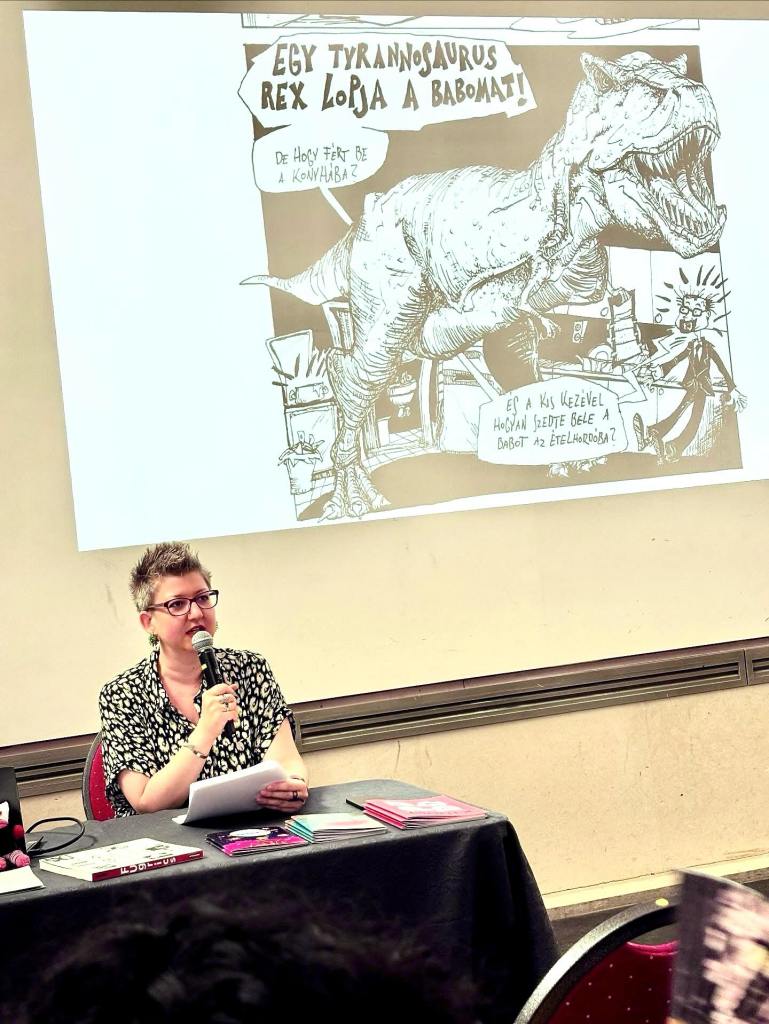
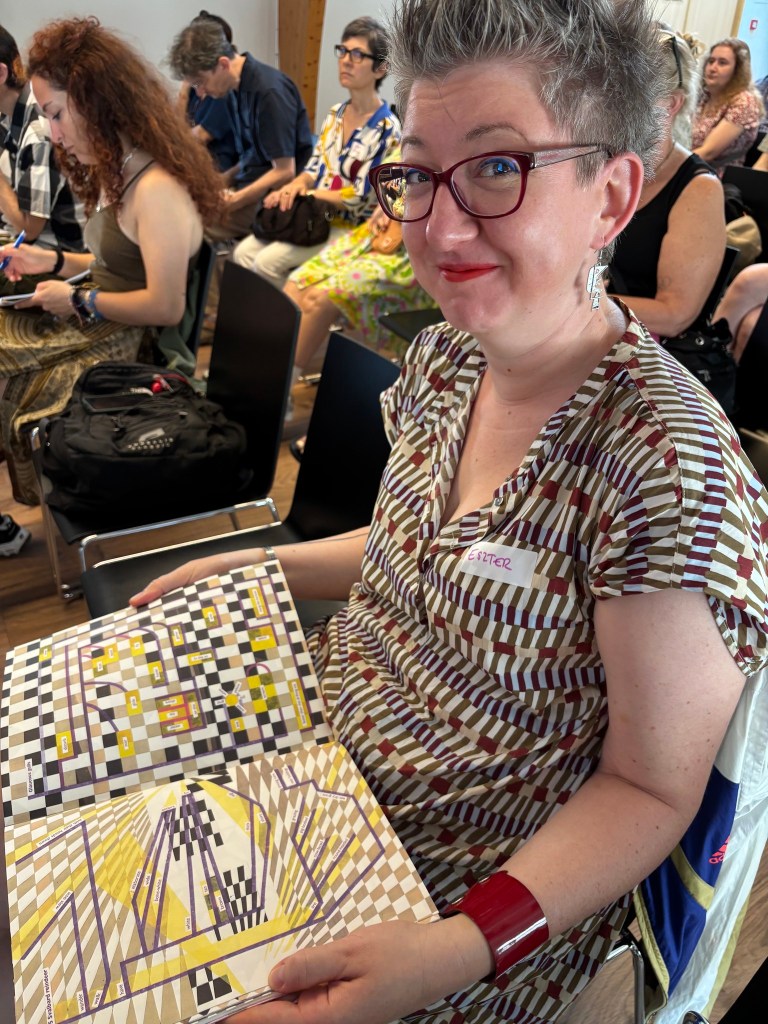
One of the greatest honors of my life has been to keynote at the joint conference of IGNCC and IBDS (International Graphic Novels and Comics Conference, International Bande Dessinée Society).
Curious about comics.
Get updates about news and blog posts.

This past year I’ve been part of the History in Comics research project, initiated by Eli Woock at Palacky University, Olomouc, Czech Republic. We have had meetings, presentations, and discussion every second month, and we have had a great time. This research group meant that I could get connected to other comics scholars and I could think about questions that are not part of my usual what the fuck is going on in Hungary? routine. I have learnt a lot from the project participants, who are:
(more…)This is the abstract of the paper that I will present next week in Dún Laughaire at the International Graphic Novels and Comics Conference. The theme of the conference is “Comics and Conscience: Ethics, Morality, and Great Responsibility”
Before the actual video, I also would like to share sketchnotes made by fantastic artist-researchers during the talk – thank you Muna, John, and Paul!
This sketchnote is by Dr Muna Al-Jawad, aka The Old Person Whisperer, who was the official sketchnoter of our panel:
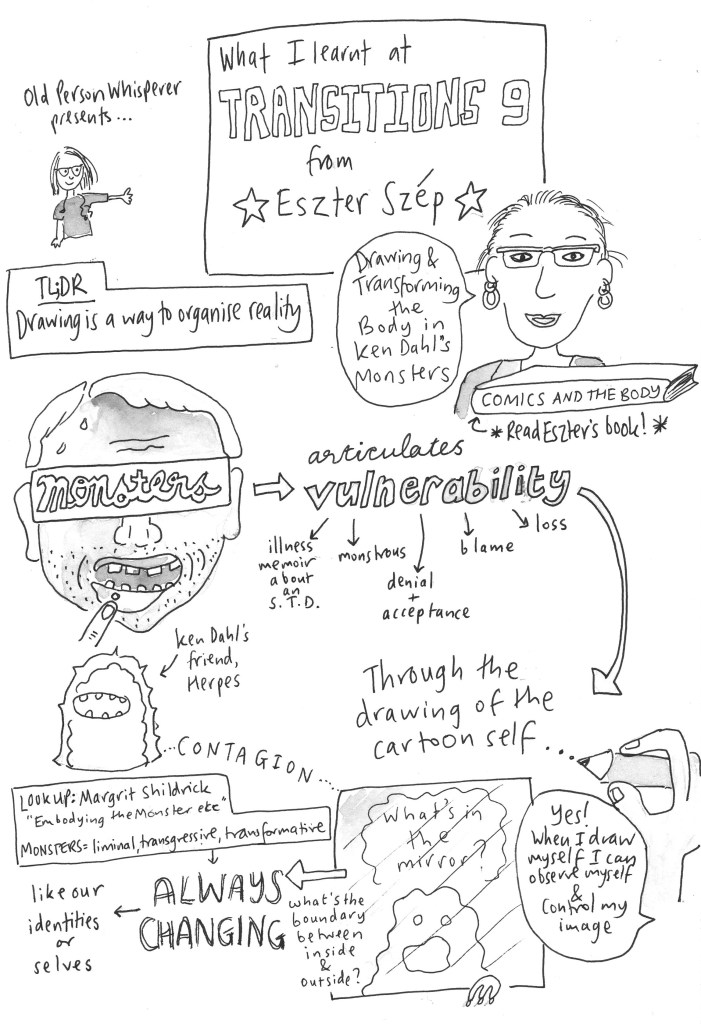
Dr John Miers also made sketchnotes:

And Dr Paul Fisher Davies mentions this talk in his sketchnote on our panel:

And now the video:
PS: This talk is based on Chapter 2 of my book, Comics and the Body: Drawing, Reading, and Vulnerability.
This is my abstract for Transitions 9: New Directions in Comics Studies 2021 (Transitions was canceled in 2020 but will take place online this year – 2021. There will be live sketchnoting during the panels! I’ll speak on 8 April about a chapter of my book that I’ve not talked about at any conferences before. – Check out the full program here.)
Ken Dahl, in his graphic narrative on living with the sexually transmitted disease of herpes, represents his avatar and personifies the illness of the avatar with cunning visual inventiveness. Dahl’s dynamic visualizations freely transform the bodies of the characters, which, I argue, emphasize drawing as a performance and as a way to think about the many controversial topics of this comic (eg. relationships, responsibility, sex, guilt, prejudice). Bodies are constantly created and recreated in acts of drawing, which offer creative ways for Dahl (pen name for Gabby Schulz) not only to find visual expressions of complex feelings and experiences regarding illness but also to testify to the endlessness of pictorial embodiment (El Refaie) itself.
The metamorphoses keep the avatar in what Margrit Shildrick called the “condition of constant becoming” (1): in a particularly vulnerable state where the repeated acts of transforming the avatar’s body are used to ask visual questions about the body. Shildrick does not talk about comics, her book, Embodying the Monster: Encounters with the Vulnerable Self, studies monstrosity and vulnerability in various cultural products: my paper applies Shildrick’s questions to Dahl’s take on normative and the monstrous bodies. I show with examples and by close reading that the morphing of the avatar’s body is expressive of vulnerability on two levels: on the level of the narrative where the illness is transforming the body, and on the level of representation, where it is the lines that govern the transformations of the body.
Content warning: Dahl uses a cartoony style to show a sexually transmitted disease, but occasionally he switches to a very realistic, photoreferential way of drawing, which can be disturbing. Actually these changes are extremely interesting.
Some personal notes:
– this conference presentation is based on chapter 2 of my book, Comics and the Body, which has, I am so happy to say, entered production phase!
– I cannot wait to meet the fantastic members of the comics community in the UK and to talk to keynote speaker Nick Sousanis again! I am 100% sure this will be a most inspiring conference!

On 24-25 May I’ll be one of the respondents at the Performativity Conference 2019, an event organized by the Narratives of Culture and Identity Research Group. Though I am a founding member of this group, I could not take part in organizing this event because of my really intensive work on the 15th International Comics Festival at Budapest.
However, I am really happy to be able to take part as a respondent, and I cannot wait to hear the inspiring papers. Book of abstracts and schedule are available here.
Lynda Takes the Line for A Walk: Attitudes and Philosophies of Drawing in Lynda Barry’s Comics
Transitions 8, 10 November, Birkbeck, University of London (detailed program)
Lynda Barry’s What It Is (2008), Picture This (2009), and Syllabus (2014) are not simply educational or self-help books on making comics, they reveal Barry’s theory about drawing and about creation. In my presentation I examine what Barry’s explanatory texts, creative exercises, and autobiographical comics inserts reveal about her philosophy of drawing.
In her exercises designed for either students or readers to engage in making drawings, Barry emphasizes the importance of bodily engagement in thinking and in creation. This idea appears in comics scholarship as well, but, unlike scholars, Barry thinks of the line as a trace of one’s personality. This way Barry engages in an ongoing discourse on the authenticity/conventional nature of the line in comics. Authenticity in non-fiction storytelling has become possibly the most overinvestigated term in the study of comics autobiography and journalism, but the relationship between the line and the drawer and the line and the story has not been studied that much.
While approaching Barry’s work, I reach back to theories of drawing by Jan Baetens, Hillary Chute, Jared Gardner, Simon Grennan, Philippe Marion, Nick Sousanis, and parallel theories in contemporary approaches to drawing in contemporary art, namely by Karen Kurczynski, Elizabeth A. Pegram, Katherine Stout. Philip Rawson’s Drawing and Laura U. Marks’ recent article “I Feel Like an Abstract Line” have shaped my understanding of the line and provide the starting point of my analysis of Barry’s work.s
As the title of the presentation hints, I believe Barry’s idea of drawing a line is closely related to that of Paul Klee. I will show that, similarly to Klee, Barry considers the line as a partner of the drawer. I also offer close readings of some of the drawing exercises Barry designed for her students and for the reader, and these pages will serve as prompts to illustrate the already mentioned theories on the nature of the drawn line.

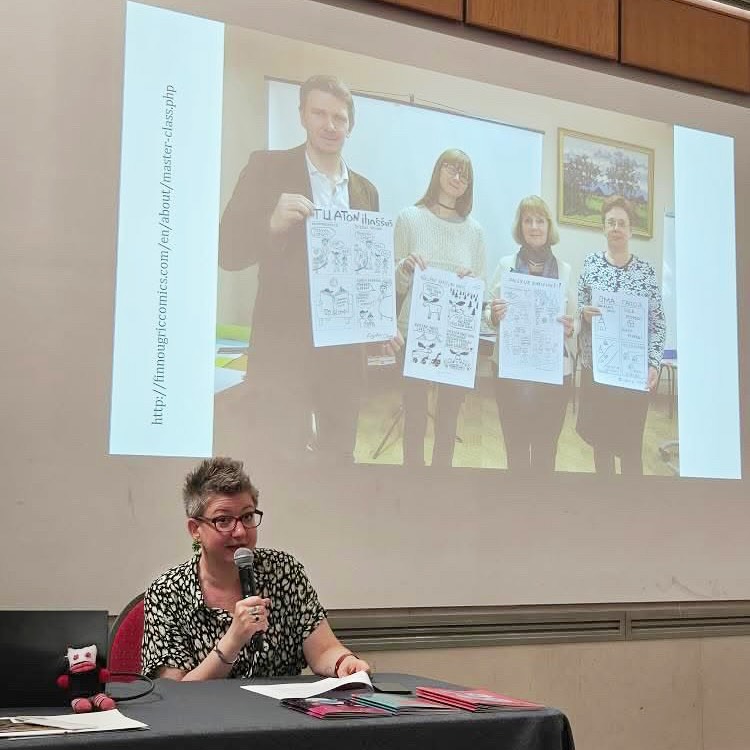
Here is the abstract of the paper I’m going to present at the Ninth International Graphic Novel and Comics Conference, Retro! Time, Memory, Nostalgia, @Bournemouth University, UK, 27-29 June 2018
“Postmortemistical” Look: The Memory of Things and the Traces of Personhood in Roz Chast and Ben Katchor
The paper investigates the ways personal relationships and memories are organized around objects and things, and how these are rearranged once the object/thing is no longer possessed by a person (due to death in Chast’s memoir, and due to abandonment in Katchor’s strips). Objects are represented in both examined comics, that is, in Roz Chast’s memoir about her last years with her parents and their deaths, Can’t We Talk About Something More Pleasant? (Bloomsbury, 2014) and Ben Katchor’s collection of strips, Julius Knipl Real Estate Photographer: Stories (Little, Brown and Company 1996), as sites of a conflict between personal memory and an apersonal and atemporal existence.
In the paper I argue that in both Chast’s and Katchor’s comics, things and objects (cf. thing theory) exist in a limbo, and are used to investigate personality and personhood in scenarios of absence. Can’t We Talk About Something More Pleasant? introduces the idea that objects, such as hairbrushes, bankbooks, photographs, and forgotten everyday objects play important and multiple roles in facing the frailty of memory, dementia and death. Things, for example old color pencils found in a drawer, represent both the past and the present, they simultaneously stand for deep personal connections and fond, and are accumulated junk the existence of which indicates future problems (can it be touched? can it be thrown away?). Likewise, Ben Katchor’s Julius Knipl Real Estate Photographer asks questions about the meaning of objects/things left behind: they exist simultaneously in a vacuum of interpretation and in the actuality of physical space. The things and objects are left behind, forgotten, stored, reserved, measured, bulked and sold, but most importantly, they are looked at and represented. The paper investigates the “postmortemistical” look (Chast) that frames these objects for the reader of the comics.
The paper utilizes questions raised by thing theory (Bill Brown and Jane Bennett), and it also builds on the materiality of living and the idea that even everyday and banal places preserve memory (reflecting on Pierre Nora’s concept). As far as methodology is concerned, I use close reading and compare recurring tropes.

I am really happy to share this piece of news with you:
“Turning the Page – Gendered Identities in Contemporary Literary and Visual Cultures” has been published. It is based on a 2-day international conference for young researchers held in 2014 at ELTE Budapest. My friend Kata Gyuris and I organized this conference, and the newly published book has been edited by Kata, Dóra Vecsernyés and me.
We have papers on soap operas and gender under Communism, ghost writers of female jazz autobiographies, motherhood in Bulgarian theatre, Italo Calvino and Jeannette Winterson, female space in contemporary African novels, crossdressing, reality tv, and many other topics!
Many thanks for Bence Bodó for the layout design, Gergely Oravecz for the cover, and for Judit Friedrich, who is the series editor.
Behold the beautiful cover and the inspiring table of contents, and you can download the full PDF for free via this link: http://www.eltereader.hu/kiadvanyok/kata-gyuris-eszter-szep-dora-vecsernyes-eds-turning-the-page-gendered-identities-in-contemporary-literary-and-visual-cultures/


Oravecz Gergely Blosszájáról fogok beszélni Kolozsváron. Arról, hogy a vonal nem csak esztétikai tényező, de a narratívában is komoly szerepe van. Sok példával.
A konferencia neve: Tendenciák a kortárs magyar képregényben és képregénykutatásban, időpontja: május 6–7.
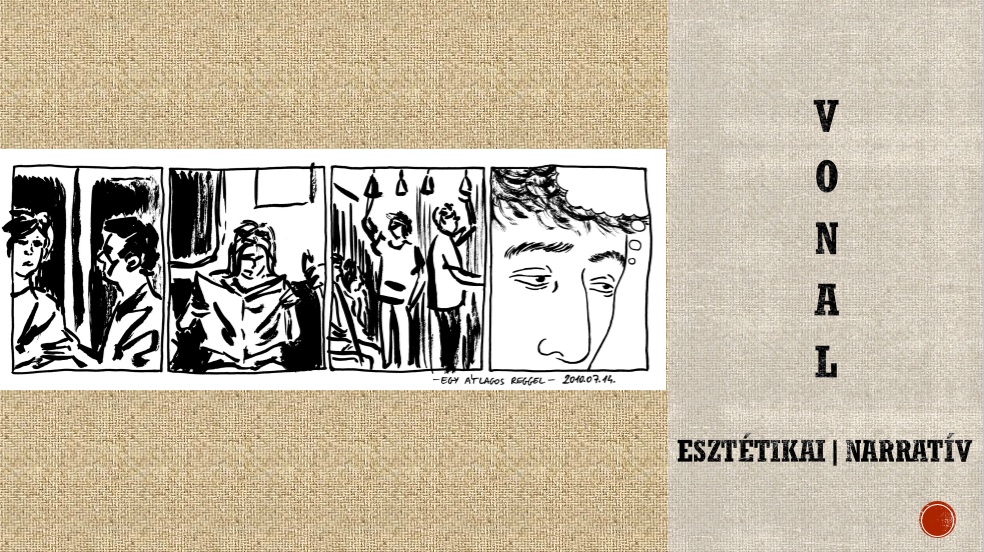
Képi testet öltés és önreprezentáció önéletrajzi képregényekben
Az előadás Oravecz Gergely Blossza c. stripsorozatában vizsgálja az alkotó önreprezentációs stratégiáit és azt, hogy ezek árnyalásához az alkotó kézjegyét és testi lenyomatát viselő vonal hogyan járul hozzá.
Elsősorban a rajzolás folyamatára és annak talán legkisebb egységére (ha létezik ilyen), a vonalra fókuszálok. A vonal Jared Gardner megfogalmazásában nyom (trace), mégpedig a rajzoló kezének közvetlen lenyomata (54). A kéz („the hand”) fogalma egyaránt jelenti az aktuálisan megrajzolt panelt vagy oldalt, illetve az alkotó felismerhető stílusát. A vonal és a kéz fogalma egyrészt a rajzolás átéltségére, hitelességére, másrészt az alkotás fizikai, testi aspektutásara utal. A véget nem érő folyamatot, amiben az identitást számtalan önarckép sorozataként hozza létre az alkotó, Elisabeth El Refaie képi testet öltésnek [pictorial embodiment] nevezi (51).
Egy olyan értelmezési keretben igyekszem tehát Oravecz Blosszáját értelmezni, mely a képregényt – tömeges és nyomdai előállítása mellett – az oralitáshoz közelíti, és a vonal (és stílus) társadalmi és kulturális kódoltsága mellett is annak performatív, átélt, és expresszív jellegét hangsúlyozza (graphic enunciation). Így válik az önéletrajzi ihletettségű képregény az autentikusság fix értelmezésétől lemondva is auratikus műfajjá (Chute 112).

Hivatkozott irodalom:
Baetens, Jan. —. “Revealing Traces: A New Theory of Graphic Enunciation.” The Language of Comics. Word and Image. Ed. Varnum, Robin and Christina T. Gibbons. Jackson: University Press of Mississippi, 2001: 145-155.
Chute, Hillary. “Comics Form and Narrating Lives.” Profession 2011: 107-117.
El Refaie, Elisabeth. Autobiographical Comics: Life Writing in Pictures. Jackson: University of Mississippi Press, 2012.
Gardner, Jared. “Storylines.” Substance 40.1. 2011: 53-69.
 Eszter Szép