Get updates about news and blog posts.

  • New Publication: Children’s Comics in Hungary

    Children’s comics is undergoing a change in Hungary: in recent years several YA graphic novels have been translated and further titles are promised. In this small country with a conservative book industry, publishers have been hesitant to publish book format comics, and publishers of children’s literature did not publish comics at all. This seems to be undergoing a change, and I am really happy about it.

    The target audience of comics in this country is 20-40 year-olds, most magazine format and book format comics are sold directly on festivals and comics fairs. The canonical works of the 1980s – comics have grown up – era are translated now + newer titles by DC and Marvel, which results in a masculine market that is a) unacknowledged by the gatekeepers of literature (literary publishers, magazines, writers, influencers) b) not particularly open to children’s titles.

    I hope that the new children’s titles will attract young readers and also hope that there will be a time when Hungarian authors will also be able to have their stories published as beautiful colorful books.

    In my essay I provide a background on the history of children’s comics in Hungary and also of the prevailing stereotypes about comics.

    The stereotype that comics will a) teach children to read or b) make children like literature is particularly strong in this country because until the 1980s the ONLY available comics were adaptations of literary works. This tie with literature was the only way comics could survive until state socialism but it has a big drawback: for decades it has been DEFAULT to compare comics to the original literary works and get disappointed. The literary work was shortened, which was deemed barbaric, the comics were text heavy (but noone noticed that in a way we do, because they did not know comics of the capitalist west), and the children were still not queuing in the library to borrow the original literary works!

    I also speculate the reasons why children’s literature is so sceptical about comics, claiming that one of the reasons is the culture of collecting toys and gimmicks, which is associated with cheap entertainment. This culture arrived in the late 1980s and in the 1990s. In this era new kinds of comics were allowed to be printed (breaking away from literary adaptations) which were most of the time related to cartoons. Children (among them myself 🙂 ) in this era met comics in a complex transmedial environment: magazines, books, stickers, notebooks, scented rubbers, cartoon series, anime series (of course we did not know the word anime). All this culture of objects and the idea of collecting are alien to the culture of children’s literature in Hungary, and I might be wrong, but this might be the first essay in Hungary that deals with this topic. (I have learned a lot about comics and transmedia from Frederick Luis Aldama’s interview with Benjamin Woo – it’s on youtube, check it out.)

    I was also asked to include how comics can be read, somehow this question is very important in Hungary. I am constantly asked how one reads comics properly, and in 2018 when I was co-curating a major comics exhibition I also had to address this issue in one of the texts on the walls. I use the “art of tensions”, the model by Charles Hatfield in Alternative Comics (2005) because I think the idea of having four layers of meaning is a simple model that shows the complex beauty of comics. This model is also very teachable – the portal where my essay is published addresses teachers and professionals working with children’s literature, and I hope they will find my essay and Hatfield’s model useful.

    https://igyic.hu/esszektanulmanyok/gyerekek-es-kepregenyek.html

  • Video: Discussing Comics with Frederick Luis Aldama

    I am honored to be part of Frederick Luis Aldama aka Professor LatinX’s videocast series: Frederick invites comics scholars to talk about how they got interested in reading and researching comics, what they do, what are the most important questions that drive them.

    In the video, I start with how I arrived at comics scholarship: at the end of my MA I was given the best advice ever, namely, that I should not start a PhD unless I am absolutely dedicated to my topic and to this path. So for a couple of years I did other things, I travelled, I worked as a teacher – and I found comics. (My MA was about John Keats, the Romantic poet and John Locke’s philosophy of language.) I also talk about the most important aspects of my book as well as some recent publications and briefly about Hungarian comics.

    I recommend listening to other episodes of the series. I have learned a lot from them, and I think it is fascinating to learn about how many different aspects of comics people are researching. This videocast is also very personal, and it is nice to get to know scholars a bit.

    My video was released some months ago but I forgot to write about it here.

  • Why is vulnerability so important in Le Guin’s Earthsea? – Patreon News

    I am happy to share with you my first finished Patreon project.

    Patreon projects help me keep on academic work in the circumstances I do not want to waste time on describing now, I have done so here, in the general introduction of my Patreon endeavor. Patreon projects are academic investigations that create a bridge between what I do in English and what I do in Hungarian, and I am really grateful for the patrons for allowing me to carry on thinking.

    MY FIRST FINISHED PATREON PROJECT has two parts: a) an essay on Ursula K. Le Guin’s Earthsea cycle in Hungarian and b) an audio / podcast on the same topic in English.

    Ursula K. Le Guin is acknowledged as one of the writers who undermined inherited fantasy tropes, wrote different quests and different conflicts, did not use characters who were evil just because they loved being evil, and, importantly, created tons of interesting female characters and made the gender of the characters a decisive factor. There is a sense of deep wisdom in all of her works.

    I show that we can understand the Earthsea cycle in a new way if we see that vulnerability is gradually becoming a central topic of the six books of the cycle. I talk about the ethics of vulnerability (which is a key idea in my upcoming book, Comics and the Body), and then I show how this works in the second book of the cycle, The Tombs of Atuan. I tried to give many examples and no spoilers. I think it is understandable even if you haven’t read the book yet. I hope so! 

    www.patreon.com/eszterszep

  • I have started a Patreon page

    These past months have been very difficult because it seems that being from Eastern Europe and being primarily a comics scholar (though I have also taught literature) make it impossible to get a job in academia either here in Hungary or in the EU / UK. This has negatively influenced all my other projects, such as our podcast, the various guest posts I write to blogs, the academic articles I should be writing (because I simply do not accept that I should quit) and I became more and more gloomy. I do not want to bore you with this, I am sure you have also had some negative spirals in your life. What usually helps in my case is watching Neil Gaiman interviews and feed on his creative positive energy.

    I have also decided to share my work (and also my difficulties) more openly because I love working on/with comics and recently I have felt so dark and alone.

    Here is a chain of tweets that explains my motives. You can find my page on patreon.com/eszterszep. I have spent some time in making the tiers personal, have a visit if you have the time.

  • Important Book on Comics in Eastern Europe is Out

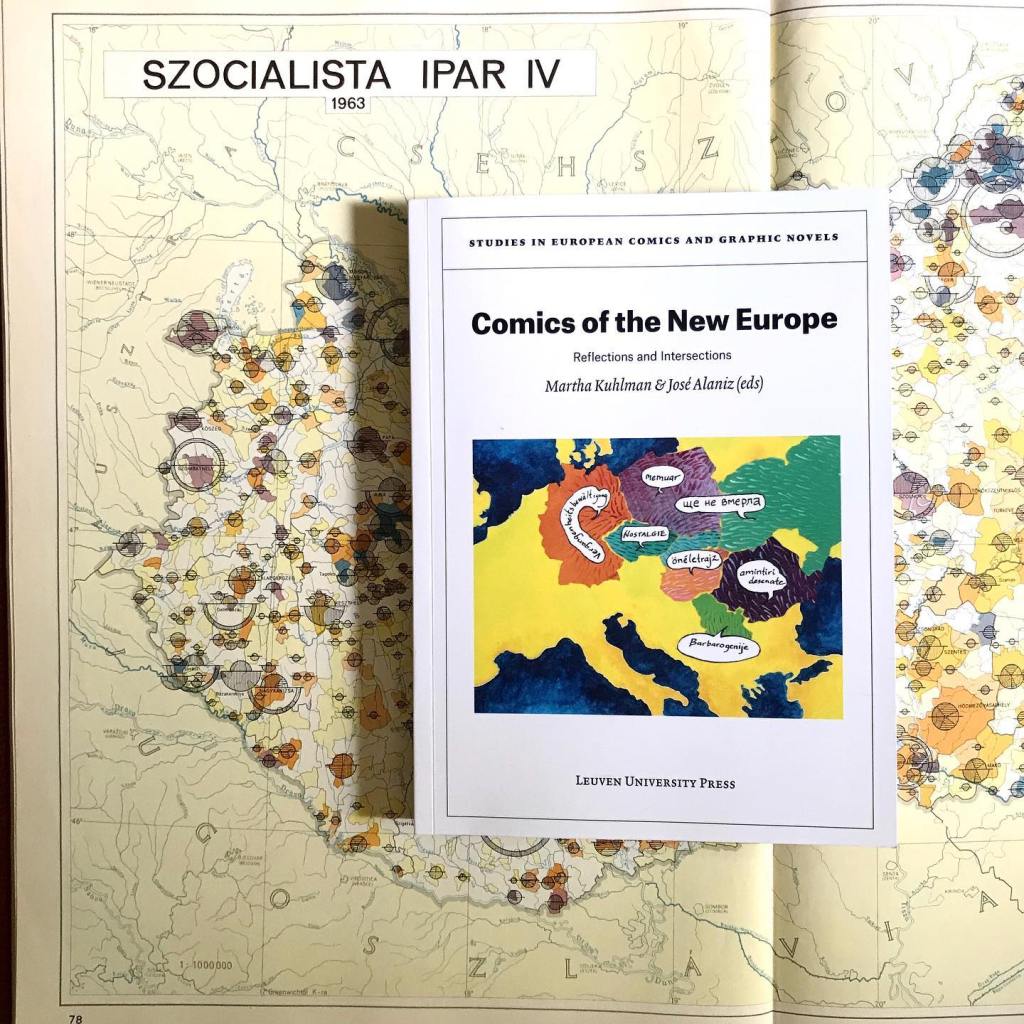
    Editors Martha Kuhlman and José Alaniz have found, explored, brought to us a topic that is hardly ever discussed: the comics of Eastern Europe. I am so happy that they thought about Hungary, too, and I could contribute with a chapter on a brief history of Hungarian comics and on contemporary autobiographical comics in Hungary. Thank you, Martha and José, for this collection.

    Often, when the phrase “European comics” is uttered, what people mean is French or Belgian comics. However, the countries of Eastern Europe have their own diverse comics traditions. Why are they diverse and what are they like? At the end of the 19th century, magazine culture was hot and trendy in Europe, and the countries of the Austro-Hungarian Empire were no exceptions. Nationalism at the rise, these countries had worked hard to have press in their native languages and not in German. These papers started publishing political satirical cartoons — just like Punch in Britain. In Hungary, these papers often borrowed German and Austrian cartoons and jokes. So the national press, at least in Hungary, was part of a broader European press culture and development of visual culture. We even ripped off the Yellow kid!

    However, before WW2 in Hungary Jewish-owned businesses were banned, and this affected many magazines and periodicals. After WW2, under the Soviet invasion, comics were banned as they were considered to have bad imperialistic American ideological influence.

    After a while, especially after the 1956 unsuccessful revolution against Soviet rule, some entertainment was offered to the people as diversion, and a few pages of comics were also published in some magazines of entertainment. These comics were adaptations of literary works, and were hugely popular.

    In Hungary, comics from the 1950s onward developed completely without American influence (some left-wing French stuff was translated later, though), and the ideological decision to exclude imperial influence had very material and aesthetic consequences: these comics look very different.

    During Soviet rule, each country in Eastern Europe had their own comics traditions, and after 1989 they each developed different discourses in the medium of comics. I am so happy that I could contribute with a chapter on contemporary Hungarian comics. Interestingly, we do not really have works that would study our past in a reflective or personal way (yet). I have seen in Comics of the New Europe that some countries have very serious and interesting working through going on in comics. I cannot wait to find out more about the collection, the Introduction, which I have had time to read so far, is really interesting.

    More on the book on the homepage of Leuven University Press.

  • My Review of Nimona and Women in Battle is Out

    … in Hungarian. The literary journal “Alföld” kindly commissioned comics reviews for its May issue (link). The plan was to sync these with the International Comics Festival Budapest. The festival was cancelled, and the journal ran out of funding so it only publishes online instead of print and cannot pay the authors for an indefinite amount of time.

    Culture is in a terrible position in Hungary, it is a noble hobby and the frustration caused by the lack of money slowly kills you inside. But I am an optimist today (my position on the optimist-let’s die now axis changes every day), and I am happy that I could write a review of these two comics in Hungarian.

    Why are these comics important?

    1. Hungary has a limited comics market: the majority of the titles is interesting for a male readership in their 30s and 40s. I can understand this: they are the ones who buy comics, and the publishers want to sell. Plus publishers belong to that age group. (Naturally, as every trend, this one exists among other trends and is not absoulute.)
    2. When the guys mentioned above were children, there were no comics that could have addressed a girl readership, so they are missing now.
    3. Some publishers realized that it is vitally important to address young readers today — they are the comics readers of the future!
    4. Some publishers realized that it is vitally important to bring in comics that are not about superheroes and white males.

    Because of points 3 and 4 in the above list, the publication of Nimona and Women in Battle is very important: they address a new reader group, that of teenage girls. I hope their audience finds them.

    (I analyze the comics scene in Hungary from a gender point of view in the 2019/4 issue of Csillagszálló. It will soon be published online at Dot &Line.)

  • “Lines and Bodies” – Academic Comic @ Sequentialsjournal.net

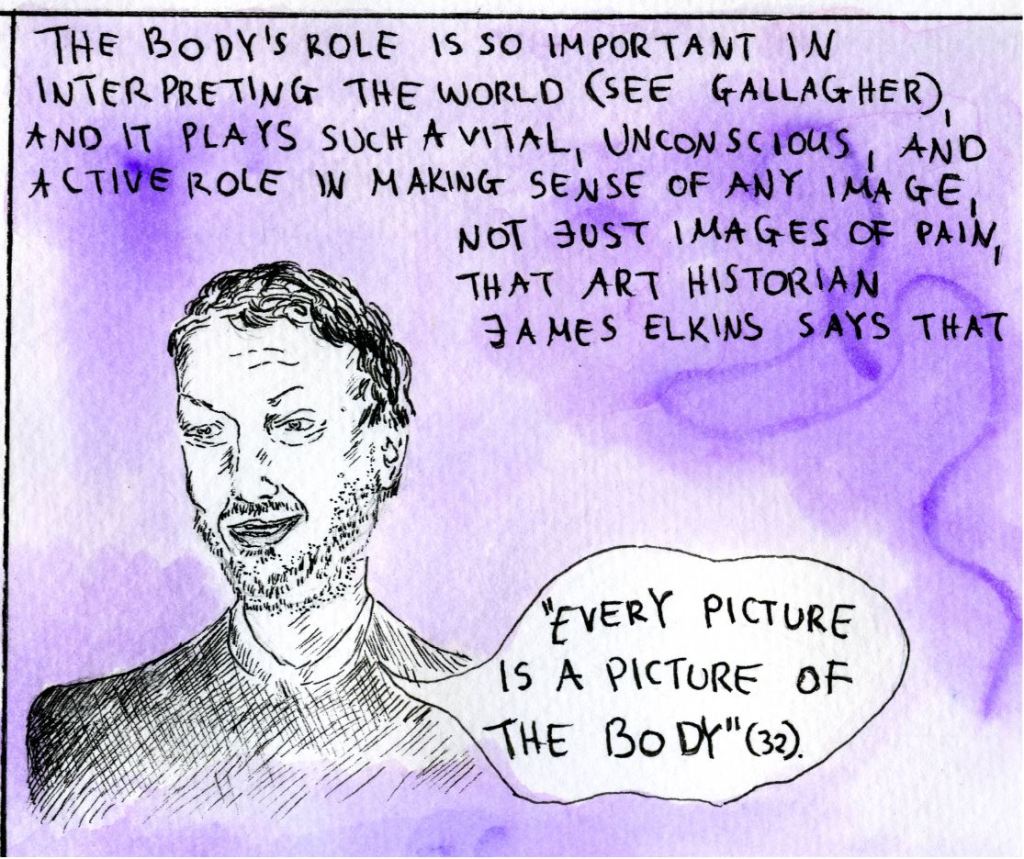
    I am happy and proud to show you the first academic comic I co-created: Lines and Bodies.

    This is an argumentative piece on some of the ways in which our bodies are involved in reading comics. It draws on theories by Laura U Marks, Robert Vischer, and James Elkins. The text and the art together show that there is more to comics than what meets the eye: in fact, we interpret lines, dynamism, direction, texture, movement based on the experiences of our bodies. These ideas are also found in my book, Comics and the Body, which will come out in November 2020 with the Ohio State University Press.

    The artist who illustrated it is Boglárka Littner, a really smart young artist who is my mentee at Milestone Institute, Budapest and who is interested in making comics and sculptures.

    Visit Sequentials journal here. Published on 1 May 2020.

  • The Cover of My Book is Here

    I am totally thrilled and mesmerized. I feel flattered by the care and attention of the editors and designers at the Ohio State University Press, and I am particularly grateful to Amanda Weiss, who drew the cover.

    The cover of my book represents everything that this book is about: first, the vulnerability of bodies, which includes that the onlooker can also experience the vulnerability of his or her body when looking at other bodies. Second, the line: I adore that this cover uses multiple pens and pencils and plays with the qualities of lines used to draw the body. Third: markmaking by hand is actually a thinking process. Fourth, the background invites touch and haptic perception. I am totally in love.

    The book will be out in November 2020.

    “The exuberance of the prose and lovely phrasing beautifully offset the topic, which is exceptionally well-researched as well as being very clearly elaborated. The book was a pleasure to read and has the potential to reshape scholarly engagements with the material and affective dimensions of comics reading processes.” —Kate Polak, author of Ethics in the Gutter: Empathy and Historical Fiction in Comics (OSU Press, 2017)

    “Eszter Szép’s book provides an analysis of the body that is currently undiscussed in the field, not only filling a gap in existing scholarship but also developing a new lens for analysis that highlights the potential for further research and study.” —Harriet Earle, comics scholar and lecturer

    Eszter Szép’s Comics and the Body is the first book to examine the roles of the body in both drawing and reading comics within a single framework. With an explicit emphasis on the ethical dimensions of bodily vulnerability, Szép takes her place at the forefront of scholars examining comics as embodied experiences, pushing this line of inquiry into bold new territory. Focusing on graphic autobiography and reportage, she argues that the bodily performances of creators and readers produce a dialogue that requires both parties to experience and engage with vulnerability, thus presenting a crucial opportunity for ethical encounters between artist and reader. Szép considers visceral representations of bulimia, pregnancy, the effects of STIs, the catastrophic injuries of war, and more in the works of Lynda Barry, Ken Dahl, Katie Green, Miriam Katin, and Joe Sacco. She thus extends comics theory into ethical and psychological territory that finds powerful intersections and resonances with the studies of affect, trauma, gender, and reader response.

  • Animals and other beasts in fantasy

    I am really happy to share that I will be one of the participants of ViTa.

    What is ViTa?
    ViTa is a day devoted to talking about all things science fiction, fantasy, weird, horror, and gaming. The acronym comes from “Meeting of Worlds” (Világok Találkozása) in Hungarian. This is now the third year that we have ViTa. I have enjoyed the first two as a member of the audience, and will be a participant this year on 30 Nov in Bem cinema, Budapest.

    Body and Fantasy
    is the title of the roundtable I am participating it. We will start off by discussing a fantasy novel published this year, Irha és bőr / Fir and Skin by Anita Moskát. This is a really sensitive, smart, and also brutal novel in which animals turn into partly human-partly animal creatures. It is cruel and clever, and I especially love the poetic language that is rich in biological metaphors. It is a novel that would really deserve to be made available for the global market. I am sure that many interesting topics will be addressed.

    I have written about Irha és bőr in Hungarian on my blog here. I have also flirted with animal studies when I was approaching Julian Barnes’ fiction. The chapter I wrote is here (the cover of the volume looks really amateurish, but the essays in it are really cool).

  • Lines, Erasure, Affect: Reading Dominique Goblet — Comics Forum, Leeds, 7-8 Nov 2019

    Here is the abstract of the presentation I am going to give at the Comics and Art and Design conference of the Comics Forum in Leeds, 7-8 November 2019. Cannot wait! This conference is always so inspiring.

    The starting point of my investigation is that comics is a drawn medium, and that this fact has intriguing consequences on how comics narratives work, how they are made, and how they are interpreted. Though there is a growing number of studies of drawing coming from comics scholarship (e.g. Gardner, Baetens, Grennan), in my presentation I apply theories of drawing coming from art history to the study of comics. Obviously, there is no direct correspondence, but I believe questions asked by art historians facilitate creative and fruitful rethinkings of the significance of drawing in comics. Focusing on drawing directs attention to comics as a process and not as a product, as well as to the transmissive nature[1] of reading comics and engagement with them.

    I will primarily rely on Norman Bryson’s “A Walk for a Walk’s Sake” (2003) and Karen Kurczynski’s “Drawing is the New Painting” (2014), and I will provide readings Dominique Goblet’s Pretending is Lying (2007) inspired by Bryson’s and Kurczynski’s insight. I will examine associations of rawness and immediacy in Goblet’s comics, and I will contrast these to the drawn photographs she also includes in her narrative. Techniques of erasure are present in both Goblet’s “raw” and “photographic” images, while erasure is a central topic of the graphic memoir itself. I will also argue that Pretending is Lying can be seen as a work in the state of becoming, one that is understood not simply by our cognitive capacities, but by the special ways our bodies understand lines.


    [1] Jill Bennett described art as transmissive in Empathic Vision (2005).